This research prototype asks whether a decision-integrity field can help a board connect purpose, strategy, culture, risk, internal control, delegation, assurance, stakeholder experience and actual outcomes without displacing formal governance or professional assurance.
Casebook / 19
Corporate governance.
Connect authority, information and consequence.
Can the board see how authority, evidence, control and consequence travel through the organisation?
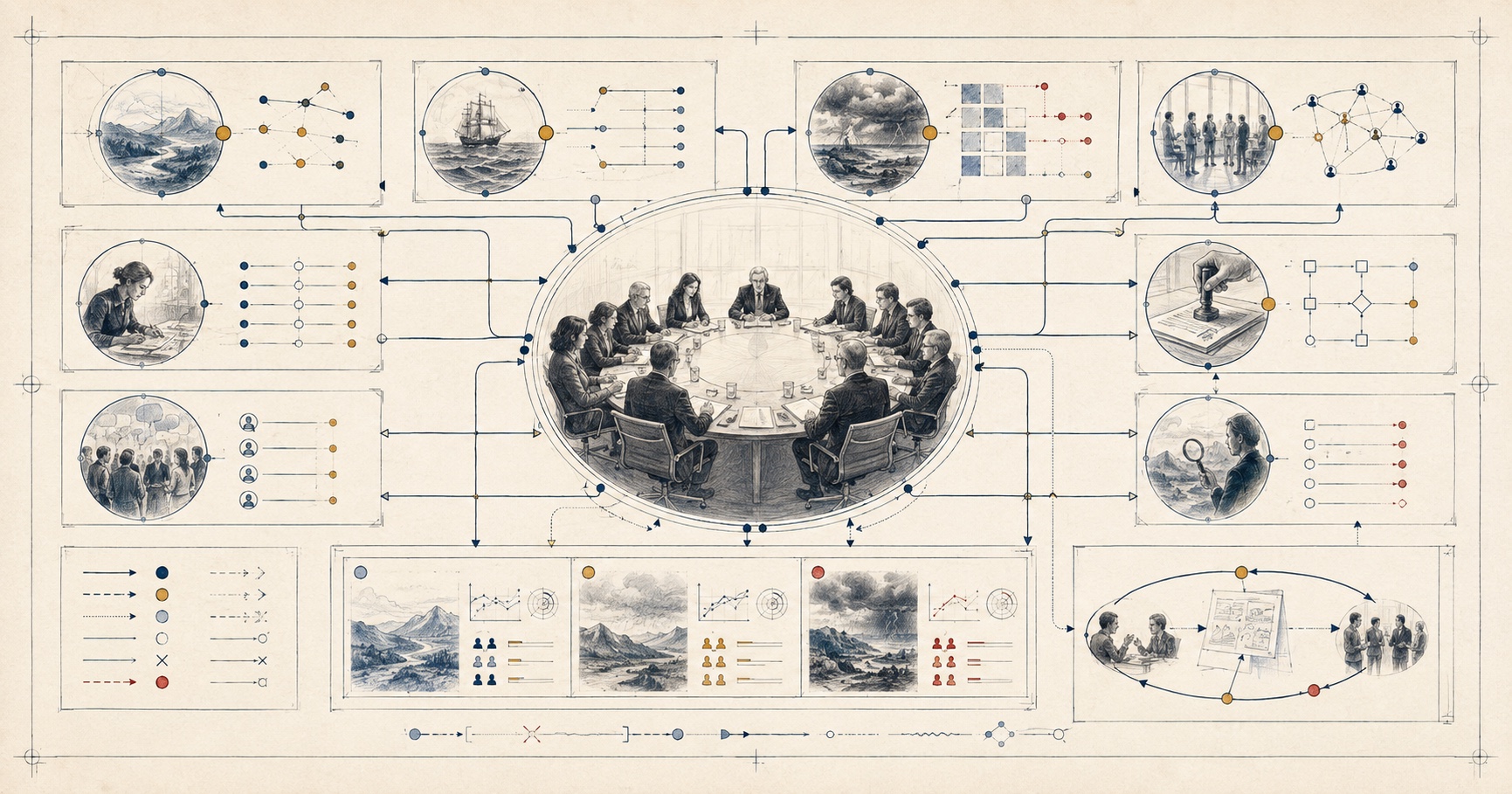
This page demonstrates a way of structuring inquiry. It does not constitute professional advice, verified intelligence, a recommendation or a conclusion about any person, organisation or transaction.
Visual field plates
Make the field visible.
Keep the claim bounded.
These original editorial plates are analytical aids, not source evidence or documentary reconstructions. They show what is being compared, where uncertainty sits and what observation would require the account to change.

The case in plain language
Start with the question,
not the answer.
Board packs, committee papers, risk registers, performance reports and assurance opinions can each be accurate while still failing to show where responsibilities, assumptions, dependencies and exceptions interact. Silence in one channel can be material when compared with evidence from another.
The method, step by step
Four moves.
One visible chain.
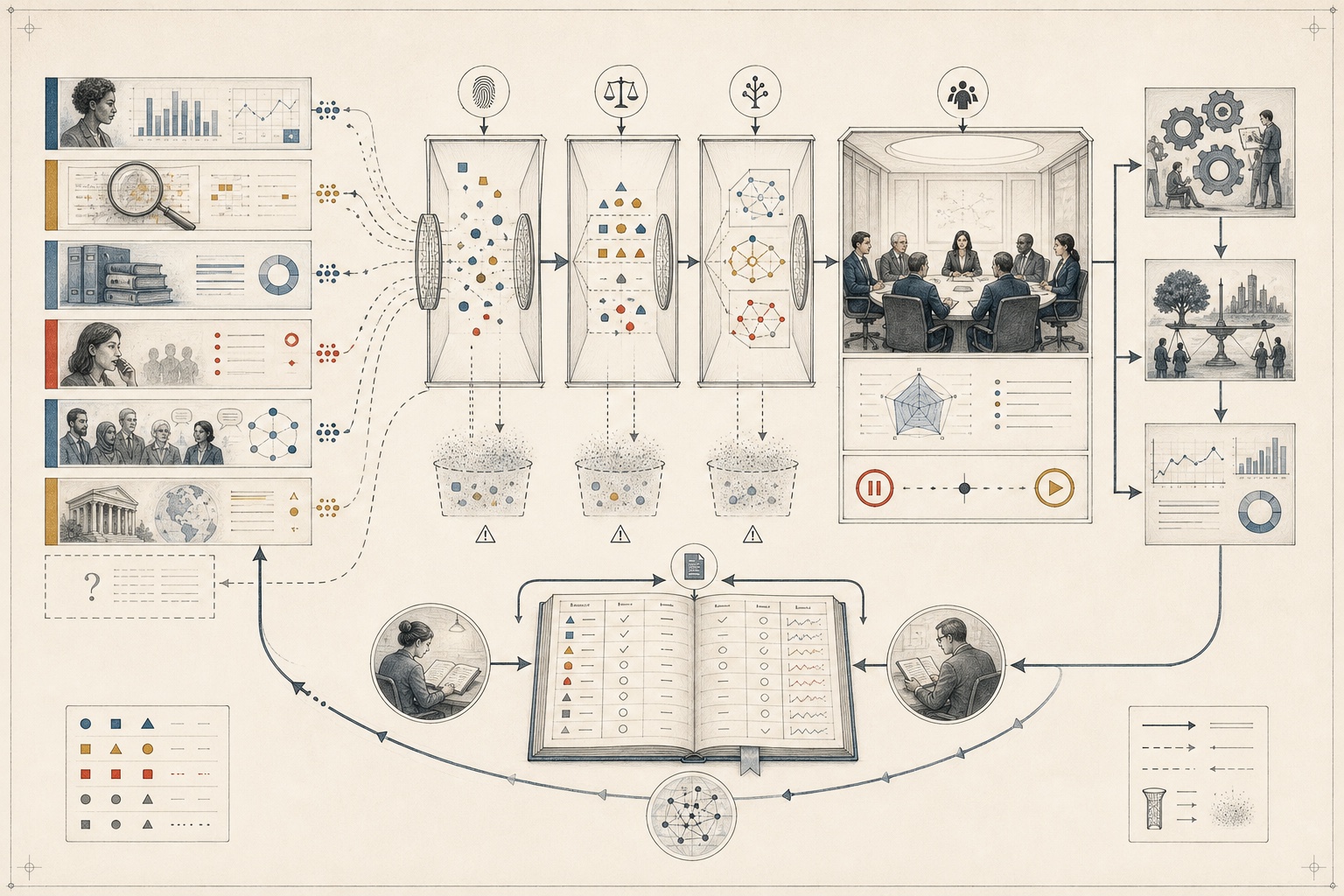
Symbiain keeps the moves separate: establish what is observed, relate the conditions, test the possible reading, and state what would require revision.
- 01 / Observe
What can we responsibly say?
The UK Corporate Governance Code 2024 emphasises effective board leadership, purpose and culture, division of responsibilities, composition, audit, risk and internal control, and remuneration. Its comply-or-explain approach also makes meaningful explanation part of accountable governance.
- 02 / Relate
What may connect?
Symbiain could provide a source-bounded governance overlay that shows decision rights, delegated action, independent challenge, material signals, competing interpretations and revision triggers in one view. It would not replace the board, company secretary, audit, risk, compliance, legal advice or statutory reporting.
- 03 / Test
What would distinguish the readings?
Against existing governance reporting, does the field reveal a material information gap, conflicting assurance, weak hand-off or unowned consequence—and does further evidence confirm that the signal deserved board attention?
- 04 / Revise
What would change the account?
Update the map when authority, strategy, risk appetite, control evidence, audit findings, stakeholder conditions or outcomes change; retain overrides, false alarms, missed signals and board corrections.
Why use Symbiain here?
From method
to practical value.
The insight is what becomes visible. The feature is what the method does. The benefit is what the user gains. The value is what can improve in the topic at hand.
- 01
Insight
Governance can fail in the space between individually competent functions when authority, evidence and consequence are not connected.
- 02
Feature
Maps board and committee authority, delegation, information flows, assurance independence, competing explanations and observed outcomes.
- 03
Benefit
Helps directors ask where a conclusion came from, what contradicts it, who owns the next action and how the decision will be reviewed.
- 04
Value
Offers a research route toward more legible, challengeable and corrigible board judgement without adding another opaque score.
What to examine
Five conditions
to hold together.
- 01Purpose, strategy, culture and the board’s stated risk tolerance
- 02Decision rights, committee remits, executive delegation and accountability
- 03Performance, control exceptions, audit, whistleblowing and stakeholder evidence
- 04Independent assurance, conflicting reports, omissions and materiality judgements
- 05Board decisions, implementation, consequences and retained correction
Tensions to hold
Delegated action ↔ board accountability
Assurance volume ↔ evidential clarity
Comply or explain ↔ boilerplate disclosure
Important boundary
Research-prototype case only. It is not legal advice, company-secretarial advice, audit, assurance, internal-control certification, regulatory assessment, director training or a judgement about any named board or company. Any real application requires the organisation’s formal governance, authorised evidence, competent professional advice and independent evaluation.
Sources & method
Sources support the stated observations only. All analytical readings remain provisional and should be tested against a defined purpose, scope and evidence base.