Question
What is being asked, by whom, for what purpose and by when?
Method / evidence / revision
Symbiain Intelligence is a decision-integrity and change-analysis practice: a structured way to orient inquiry around conditions, relationships, pressure, feedback and change.
It does not make uncertainty disappear, monitor people or replace professional judgement. It works on a bounded question with permissioned evidence, making the moves from evidence to interpretation more inspectable, testable and corrigible while accountable people retain authority.
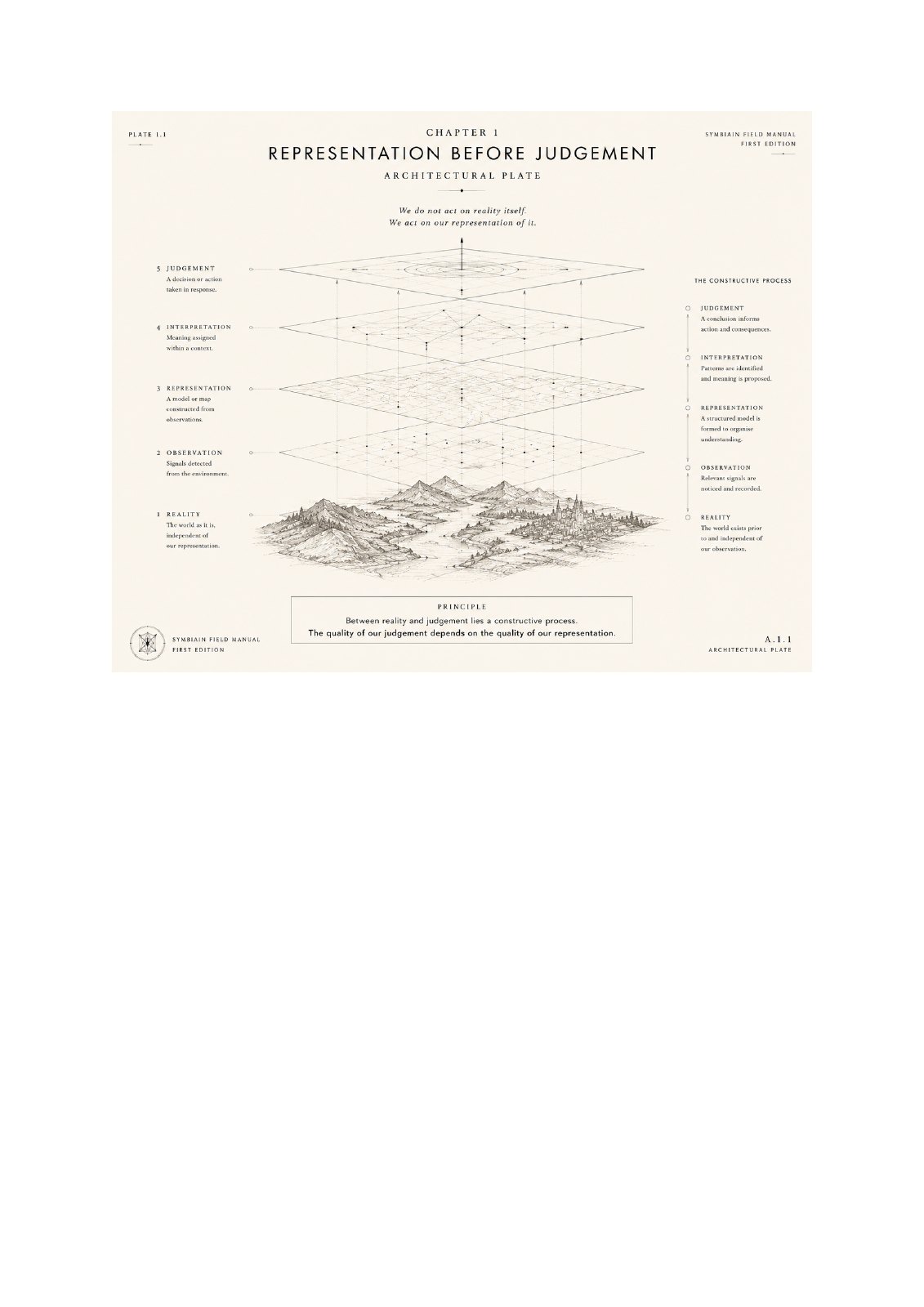
From the Symbiain Field Manual
The working order matters: reality is encountered through observation; observation becomes a representation; a representation is interpreted; and only then can a judgement be made. Each move introduces assumptions that must remain open to challenge.
The plate is a visual orientation device, not a claim of certainty. It asks the reader to locate the current account before relying on it.
The governing distinction
System is not observation. Observation is not model. Model is not claim. Claim is not decision.
The seven-field sequence
The sequence is a set of questions, not a claim that every system changes in seven fixed stages.
The conditions from which a field becomes legible.
What is actually present?02Actions that organise how meaning is made.
What is acting on what?03Configurations made through repeated interaction.
What connects, enables or constrains?04Patterns formed in combination, not presumed primitives.
What is forming in combination?05A question about mechanism, not a shortcut from pattern.
What mechanism could explain this?06Polarities that create pressure, ambiguity and movement.
Where is pressure accumulating?07Transition becomes visible through pressure, feedback and recalibration.
What is changing — and what would change our mind?The inquiry loop
The seven fields say what to examine. The four moves say how to work with what is found.
Begin with the trace: what is present, recorded, measured or reported?
Ask what connects, enables, constrains, amplifies or feeds back.
Hold more than one reading and seek evidence that can discriminate between them.
Update the account when new evidence, consequence or contradiction arrives.
The evidence register
These labels are not a ranking from weak to strong. They identify different evidential states that should not be silently exchanged.
A proposition supported by an identified source and checked within the stated scope.
A proposition attributed to a named source, whose underlying basis may still require verification.
What is directly present, recorded or measured before meaning is assigned to it.
Two conditions move or appear together; this does not by itself establish mechanism or cause.
A reasoned interpretation drawn from evidence, with the connecting logic made visible.
A provisional explanation that can be tested against alternatives and disconfirming evidence.
A claim made by a person or source that is not treated as established merely because it is reported.
A decision-ready working output
What is being asked, by whom, for what purpose and by when?
Which geography, period, actors, sources and exclusions define the work?
Which conditions, relations, pressures, constraints and feedback matter?
What other explanations remain plausible, and what evidence separates them?
Which gaps prevent a stronger claim or require specialist verification?
What new evidence, threshold or consequence would change the reading?
The discipline of use
Symbiain’s value lies not in adding symbolism, but in making a line of reasoning inspectable: its inputs, assumptions, alternatives, corrections and limits can be seen and challenged.
State the stable units, inputs, context weights, transformation rules, outputs, intended uses, prohibited uses, assumptions and failure modes.
Predefine a small set of suitable public or historical cases, the rules of review and the comparison baseline before outcomes are examined.
For each conclusion, record the source, observation, interpretation, alternative explanation, confidence level and revision trigger.
Record how a mistaken classification, weight, assumption or interpretation is detected, corrected and retained as part of the learning record.
When a symbolic prompt is used, show the question it generated, the evidence sought and whether that evidence supported, complicated or contradicted it.
Define the process, hand-offs, records, losses, exceptions and final outcome—then make the reasoning at each stage available for review.
A practical gloss
In practice, Symbiain helps a person, team or institution separate what is known from what is assumed; identify the forces, incentives and relationships shaping a situation; hold more than one credible explanation in view; test what would distinguish them; and update the account as evidence arrives.
Symbolic prompts are deliberate devices for shifting attention and challenging habitual framing. They do not claim hidden knowledge, predictive authority or proof; every prompt remains subordinate to sources, reasoning and revision.
Practise the distinction
Field Observation Training is a guided visual exercise built around the Qingming scroll. It turns the method into a sequence of practical moves: observe the field, locate relations and constraints, hold alternatives open, and state what would change the reading.
Open Field Observation Training →Apply the method to AI
The AI Hallucination Audit case applies the same discipline at claim level: preserve the prompt and model context, decompose the response, inspect source provenance and entailment, retain uncertainty, and route consequential gaps to accountable human review.
Explore the AI Hallucination Audit →Intellectual neighbours
Symbiain sits alongside systems thinking, source criticism, causal reasoning, scenario work and structured analytic techniques such as Analysis of Competing Hypotheses. It does not claim to supersede them.
Its distinctive emphasis is the visible arrangement of condition, relation, pressure, feedback, provenance and revision around a bounded question. Whether that emphasis improves judgement is an empirical matter to test—not a benefit to assume.
Read the Heuer, ACH & Symbiain case →See the method applied