Trace the compound back to its conditions
Field guide / 04 of 07
Compounds.
Make the field legible.
Compounds are recognisable patterns that arise from elements and relationships. They should be explained through their conditions, not treated as self-evident givens.
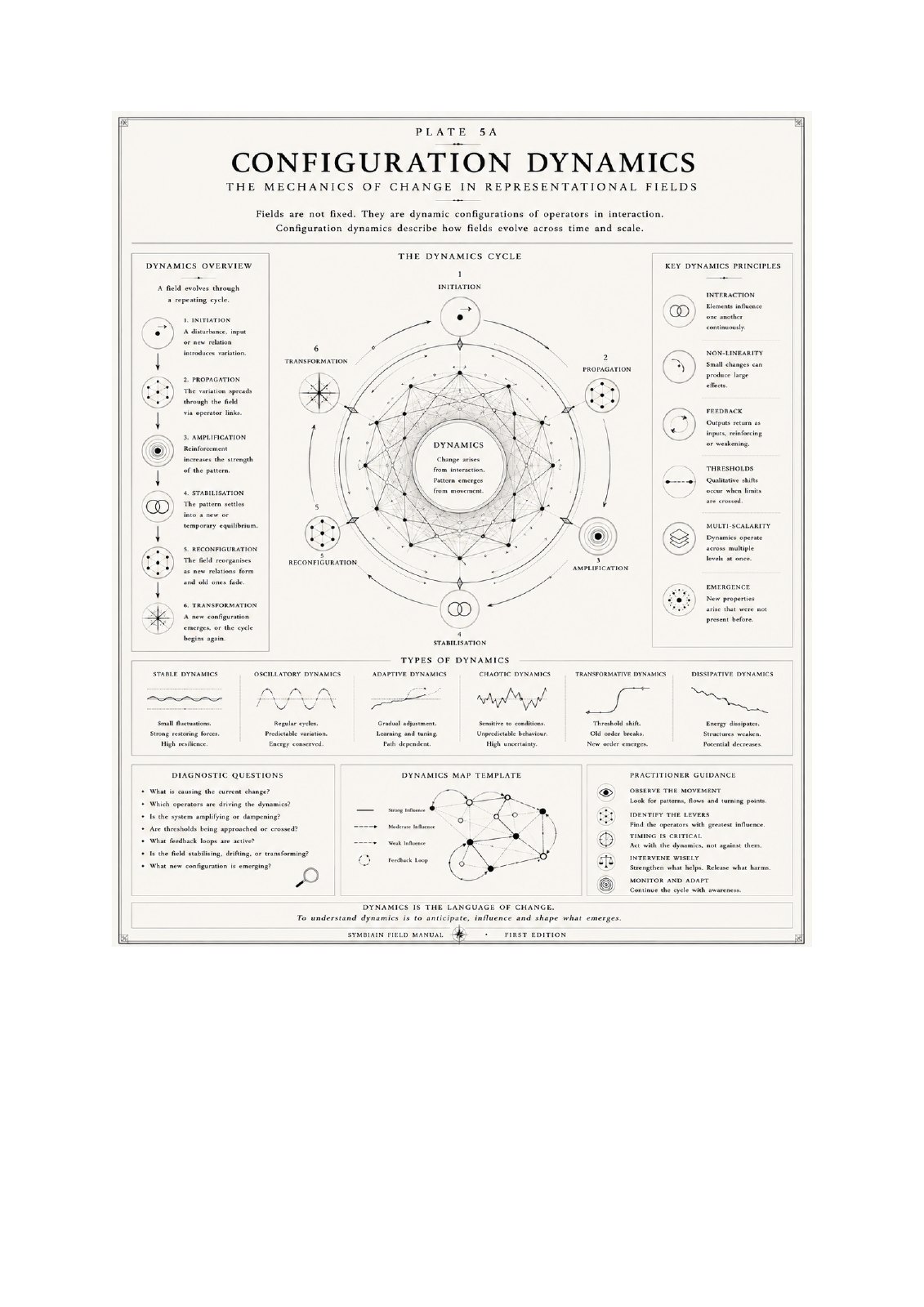
A compound is a configuration in motion, not a fixed essence.
The illustrated lesson
See the move.
Then make it.
Four web plates translate the Field Manual into a usable sequence: structure, application, record and practice. Read them in order, or return to the plate that your decision needs.
What is forming in combination?
Follow one bounded example through the method.
Running case / critical-component delivery
Repeated delay and slow feedback have produced the compound judgement “low trust”.
- 01Decompose
Trust is not treated as a fixed property of the supplier.
- 02Configure
Prediction accuracy, exception notice, response quality and repair history combine.
- 03Test
A different configuration could produce dependable performance even after a failure.
- 04Reform
Change notice timing and repair behaviour, then observe whether trust is rebuilt.
An abstract judgement becomes a set of conditions that can be monitored and influenced.
A useful method leaves a record that another person can question.
Produced record
Configuration account
A named compound, the conditions that sustain it, and the changes that could alter its form.
Provisional
Revisable
Revisable
01Source
Where did the information come from?
02Status
Observed, reported, inferred or unknown?
03Boundary
To what time, place and scale does it apply?
04Revision
What evidence would alter the account?
Do not treat a compound as an essence. A label is not an explanation.
A bounded 12 minutes field exercise.
01
Choose a label such as trust, power, resistance or conflict.
02
List the observable conditions from which it may emerge.
03
State which relationships sustain those conditions.
04
Name one change that could alter the configuration.
You are finished when the compound can be explained without using the compound itself as its own cause.
The reading frame
What to look for
before you decide.
What is forming in combination?
- 01Trust — reliance under uncertainty
- 02Identity — continuity of a recognised form
- 03Belief — a held orientation
- 04Goal — a selected future state
- 05Motivation — pressure toward action
- 06Power — uneven capacity to affect
- 07Conflict — incompatible orientations
In practice
Three useful
moves.
Compounds turn vague labels into configurations that can be examined, challenged and sometimes changed.
Ask what sustains it
Identify what could alter its form
Calibration notes
Do not treat a compound as an essence
A label is not an explanation