Map the active links
Field guide / 03 of 07
Relationships.
Make the field legible.
Relationships give elements their force. Repeated interaction creates a configuration with its own opportunities, dependencies and points of failure.
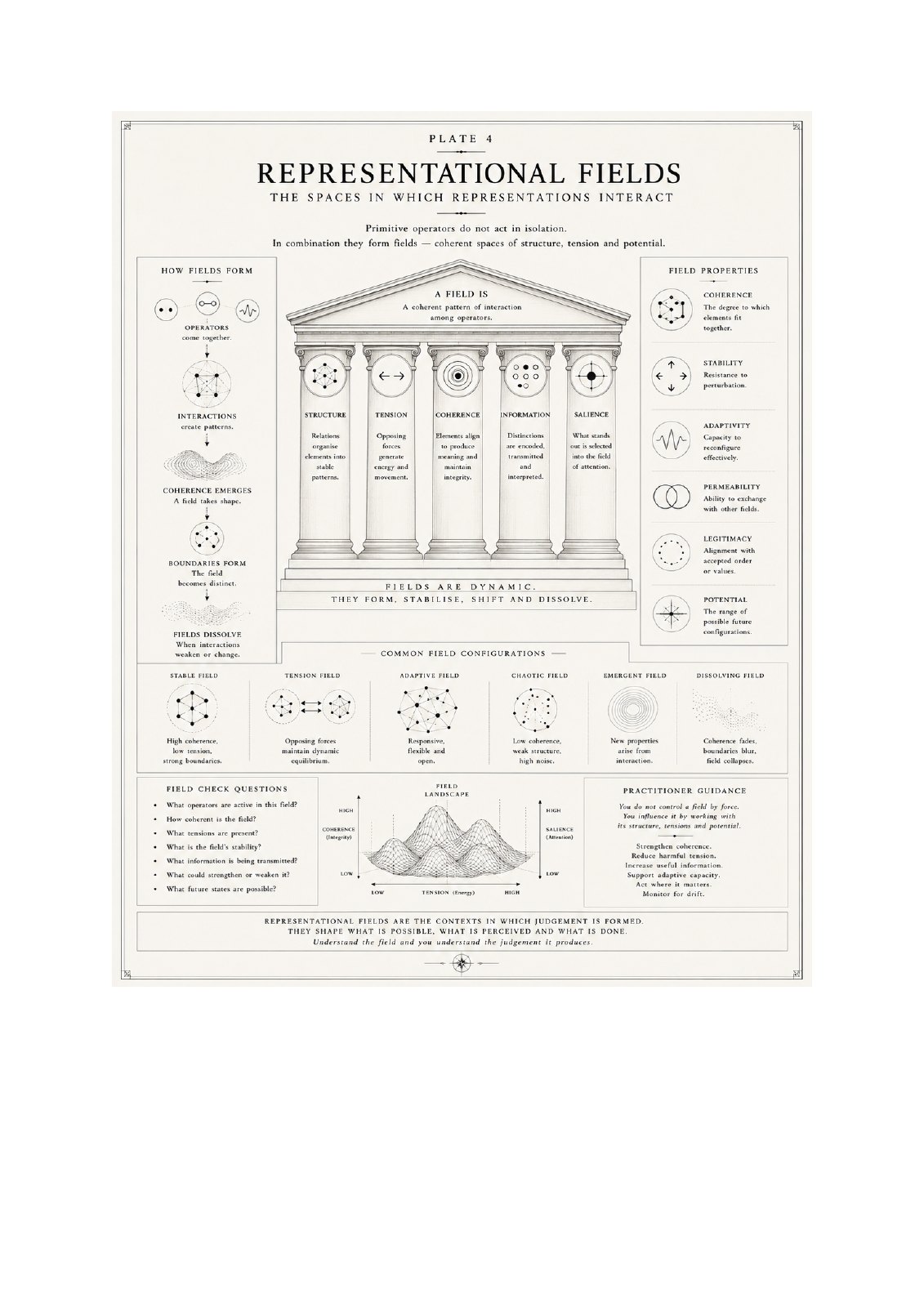
Relations make a field: patterns emerge through connection, dependence and feedback.
The illustrated lesson
See the move.
Then make it.
Four web plates translate the Field Manual into a usable sequence: structure, application, record and practice. Read them in order, or return to the plate that your decision needs.
What connects, enables or constrains?
Follow one bounded example through the method.
Running case / critical-component delivery
The component does not move from supplier to buyer directly; it passes through a connected field.
- 01Connect
Supplier release, carrier collection, customs clearance, warehouse intake and inspection form one chain.
- 02Weight
A single inspection hand-off carries more delay risk than the other links.
- 03Feedback
Arrival variance is reported after the next order is already released.
- 04Repair
Earlier exception notice would allow the schedule or transport route to be revised.
Responsibility stops looking like a single actor’s trait and becomes a repairable configuration of dependencies.
A useful method leaves a record that another person can question.
Produced record
Relationship map
Actors, dependencies, hand-offs, feedback loops and weak or overloaded connections.
Provisional
Revisable
Revisable
01Source
Where did the information come from?
02Status
Observed, reported, inferred or unknown?
03Boundary
To what time, place and scale does it apply?
04Revision
What evidence would alter the account?
A connection is not necessarily a cause. Stability can conceal dependency.
A bounded 15 minutes field exercise.
01
Place the decision or outcome at the centre.
02
Add every actor, record and resource it depends upon.
03
Draw the direction of each hand-off and feedback path.
04
Mark the one relationship carrying disproportionate load.
You are finished when the map shows where information or action can stop, arrive late or return too slowly.
The reading frame
What to look for
before you decide.
What connects, enables or constrains?
- 01Compatibility — can parts work together?
- 02Feedback — what returns to alter the field?
- 03Repair — how is disruption addressed?
- 04Coordination — how are actions aligned?
- 05Dependency — what cannot proceed alone?
In practice
Three useful
moves.
This exposes hidden hand-offs, single points of dependence and places where repair can restore the whole field.
Find the feedback loop
Locate the relationship carrying disproportionate load
Calibration notes
A connection is not necessarily a cause
Stability can conceal dependency