Describe the current state and its drift
Field guide / 07 of 07
Change.
Make the field legible.
Change becomes legible through a loop: observe conditions, form a provisional account, act, receive feedback and update the account.
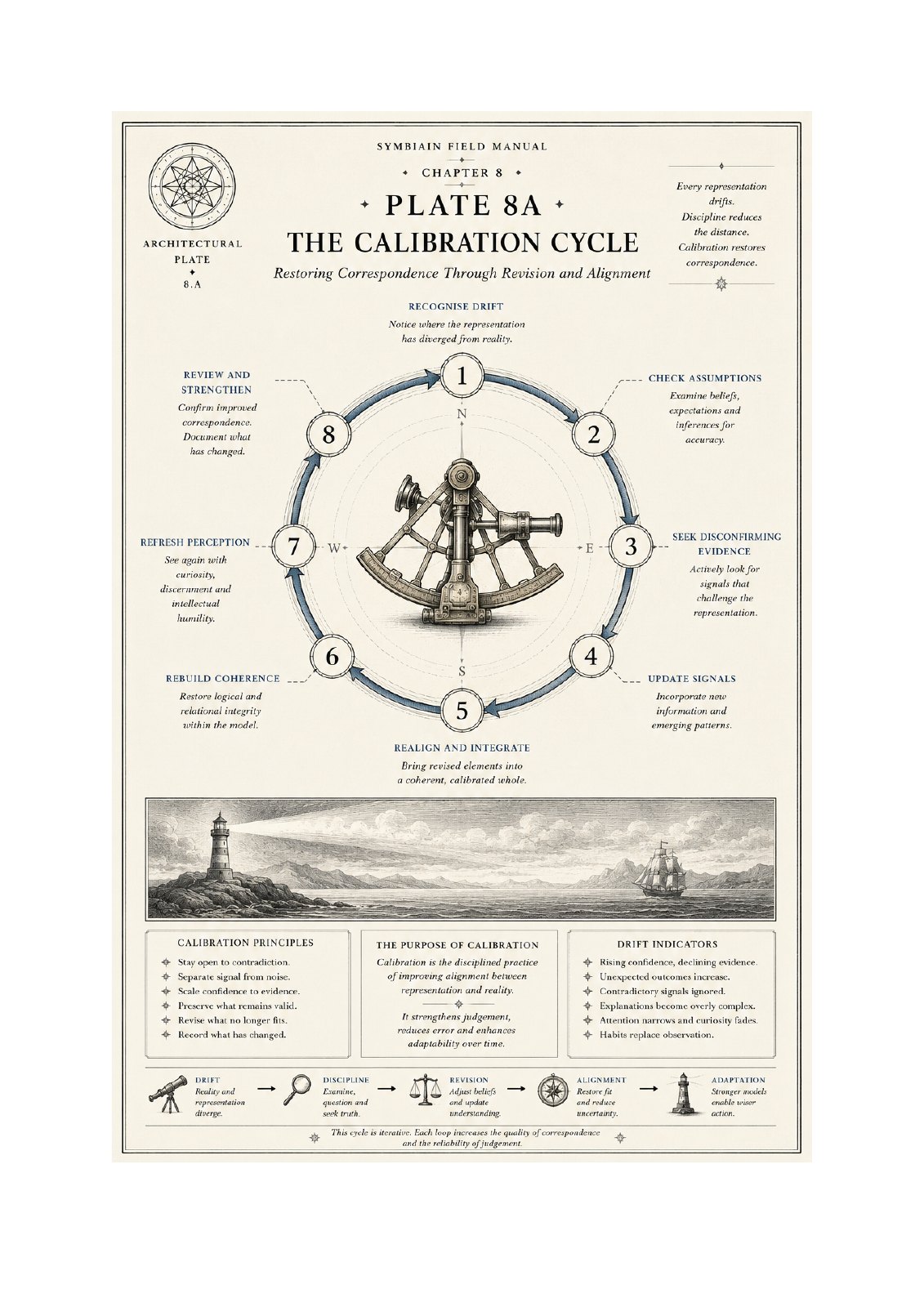
Change becomes useful when feedback can revise the account.
The illustrated lesson
See the move.
Then make it.
Four web plates translate the Field Manual into a usable sequence: structure, application, record and practice. Read them in order, or return to the plate that your decision needs.
What is changing — and what would change our mind?
Follow one bounded example through the method.
Running case / critical-component delivery
The component field now has a bounded record, mapped operations, relationships, compounds, mechanisms and tensions.
- 01Baseline
Delivery promise, route, inspection time and buffer policy establish the reference.
- 02Move
Introduce earlier exception notice for one order without changing the whole system.
- 03Feedback
Measure notice time, rescheduling success, arrival variance and inspection pressure.
- 04Revise
Retain, alter or abandon the intervention and record what changed in the account.
The method ends with an update, not a defended conclusion: the record shows what was learned and what remains uncertain.
A useful method leaves a record that another person can question.
Produced record
Revision record
Baseline, observed drift, action, feedback, outcome and the resulting update to the working account.
Provisional
Revisable
Revisable
01Source
Where did the information come from?
02Status
Observed, reported, inferred or unknown?
03Boundary
To what time, place and scale does it apply?
04Revision
What evidence would alter the account?
A transition is not necessarily progress. Recalibration is not an admission of failure.
A bounded 15 minutes field exercise.
01
Write the baseline and the observed departure from it.
02
Choose one reversible action with a named owner.
03
Specify the feedback and review date in advance.
04
Record whether the result supported, complicated or contradicted the account.
You are finished when the new account preserves what changed, why it changed and what evidence would trigger another revision.
The reading frame
What to look for
before you decide.
What is changing — and what would change our mind?
- 01Observe — encounter a condition
- 02Classify — make a provisional distinction
- 03Infer — form a working account
- 04Act — test a move in the field
- 05Collect feedback — receive consequence
- 06Reconstruct — update the account
In practice
Three useful
moves.
Change becomes a learnable sequence rather than a dramatic event noticed only after the system has already reorganised.
Name the next reversible move
Specify what feedback would revise the account
Calibration notes
A transition is not necessarily progress
Recalibration is not an admission of failure