Human-governed research field / embodied systems
Decision integrity
for embodied and
consequential AI.
Help people understand what an automated system knows, what it does not know and why it is asking for a decision—without surrendering human authority.

Symbiain is a bounded review and assurance proposition—not a motion controller, autonomous authority or system for ambient surveillance. It works with approved evidence around a defined question. Safety-critical systems remain independent and authoritative; accountable people retain every consequential decision.
The public operating boundary
Intelligence should enlarge
human agency.
Public trust begins with a clear answer to what the system will never be allowed to do. These boundaries govern any proposed research, pilot or application.
- 01 / BOUNDED PURPOSE
One declared question.
The purpose, source base, exclusions, decision owner and stop conditions are named before work begins.
- 02 / CONSENT & ACCESS
Permissioned evidence only.
No covert collection, ambient monitoring or unrestricted trawling of private records is part of the Symbiain offer.
- 03 / NO PEOPLE SCORING
Behaviour is not identity.
Observable actions remain separate from inferred motive, emotion, character or risk. Symbiain does not claim to read minds.
- 04 / HUMAN AUTHORITY
People decide and can stop.
Consequential judgement, intervention and escalation remain with a named, accountable human who can challenge, override or end the process.
The distinctive contribution
Not another model.
A visible decision field.
AI and robots can fail not only because their information is incomplete, but because they cannot show what conflicted, what they inferred, who should decide and what would make them revise their account.
Symbiain holds those distinctions together without pretending they are the same thing. The aim is a calmer, more legible route from permissioned evidence to accountable human action.
The operating sequence
From signal
to retained learning.
- 01Sense
- 02Register
- 03Represent
- 04Challenge
- 05Decide
- 06Act · Hold · Escalate
- 07Reconcile
- 08Learn
The order creates places to pause. A signal does not silently become a fact; a representation does not silently become a decision; and an action does not disappear before its consequence is reviewed.
The best first problem
Manage the conflict
before controlling the motion.
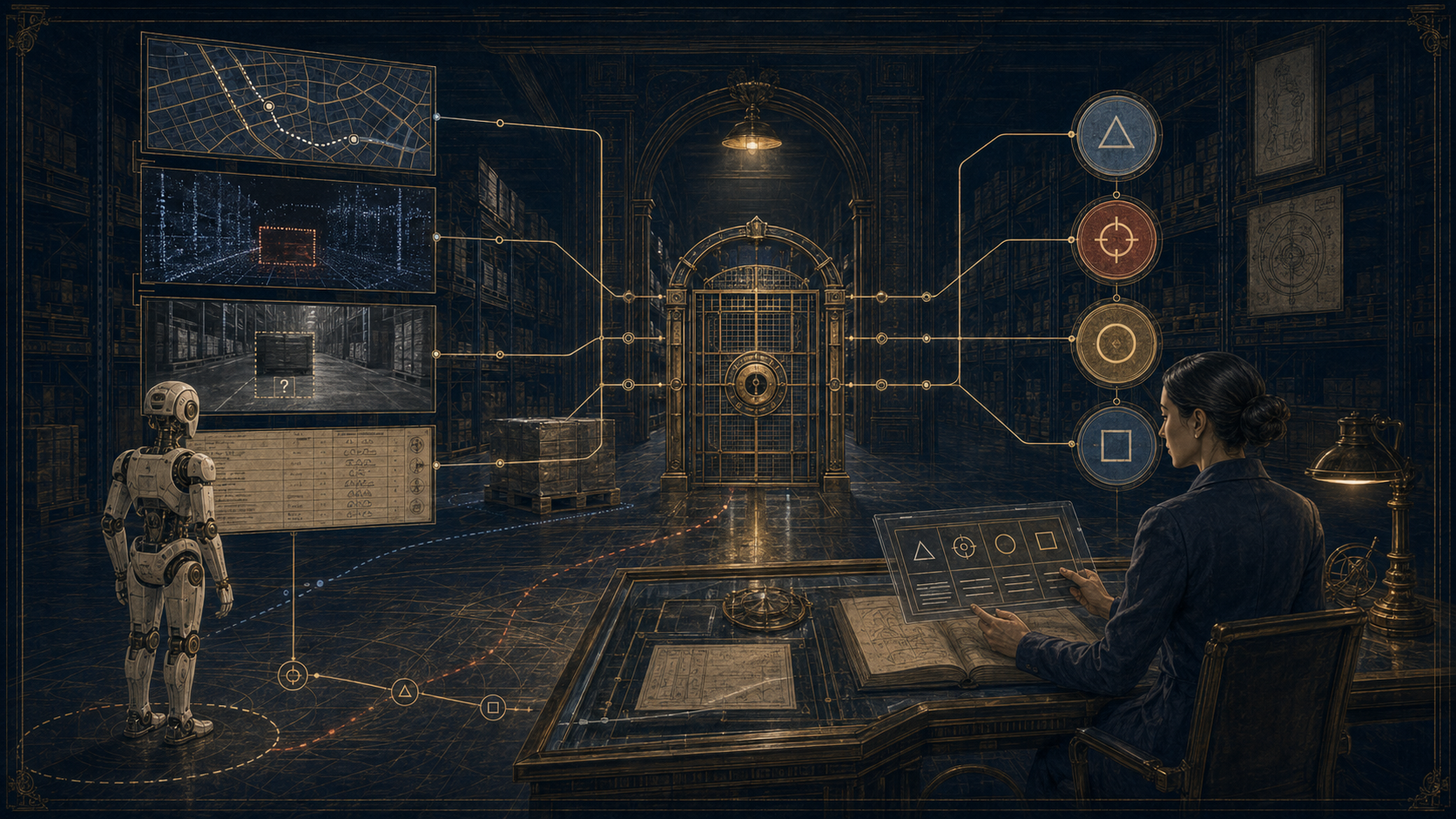
A warehouse map says the route is clear. Lidar shows an obstruction. The camera is uncertain. The job record assumes access. A pallet may have moved without the record changing.
Symbiain turns that disagreement into a managed decision object: what is observed, what is recorded, what is inferred, what else may explain it, who may clear it and what evidence permits revision.
The application field
Twelve places
decision integrity matters.
Each problem is framed as a bounded contribution and a safe first application—not as evidence that Symbiain controls, profiles or certifies a deployed system.
- 01
Conflicting evidence
Keep sensor, map, record and human reports distinct when they disagree.
FIRST FIELD / Warehouse route exception - 02
Autonomy under ambiguity
Make act, constrain, rescan, hold and escalate available as explicit states.
FIRST FIELD / Obstructed mobile-robot route - 03
Usable explanation
Give an operator an evidence-and-reasoning card, not a confidence score alone.
FIRST FIELD / Pause or reroute review - 04
Human handover
State what a person needs to know, decide and record at the escalation point.
FIRST FIELD / Logistics or quality exception - 05
Reasoning audit
Retain the path from source and observation to action, outcome and correction.
FIRST FIELD / Post-incident review - 06
Automation bias
Surface alternatives and disconfirmation before a plausible recommendation is accepted.
FIRST FIELD / Anomaly or risk triage - 07
Operational drift
Distinguish a changing site, model or practice from a presumed stable baseline.
FIRST FIELD / Repeated route exceptions - 08
Mixed operational data
Relate records, sensors, people, rules, assets and thresholds without flattening them.
FIRST FIELD / Maintenance coordination - 09
Language-model agents
Bound sources, authority, uncertainty and escalation around organisational records.
FIRST FIELD / Read-only exception assistant - 10
Misleading learning loops
Measure consequence and correction, not task completion alone.
FIRST FIELD / Fleet near-miss review - 11
Interaction ambiguity
Keep observable interaction separate from inferred intent; do not profile or pretend to read minds.
FIRST FIELD / Consent-based service and collaborative robotics - 12
Inflated intelligence claims
Label evidence quality, unknowns and authority limits explicitly.
FIRST FIELD / AI and robotics demonstrators
Operator-facing explanation
Hand over
the decision, not the noise.
“Anomaly detected” is not a useful transfer of authority. A human needs the relevant evidence, bounded interpretation, credible alternatives, immediate risk, safe options, missing information and the precise decision that requires human judgement.
Research and validation pathway
Invite challenge.
Earn the stronger claim.
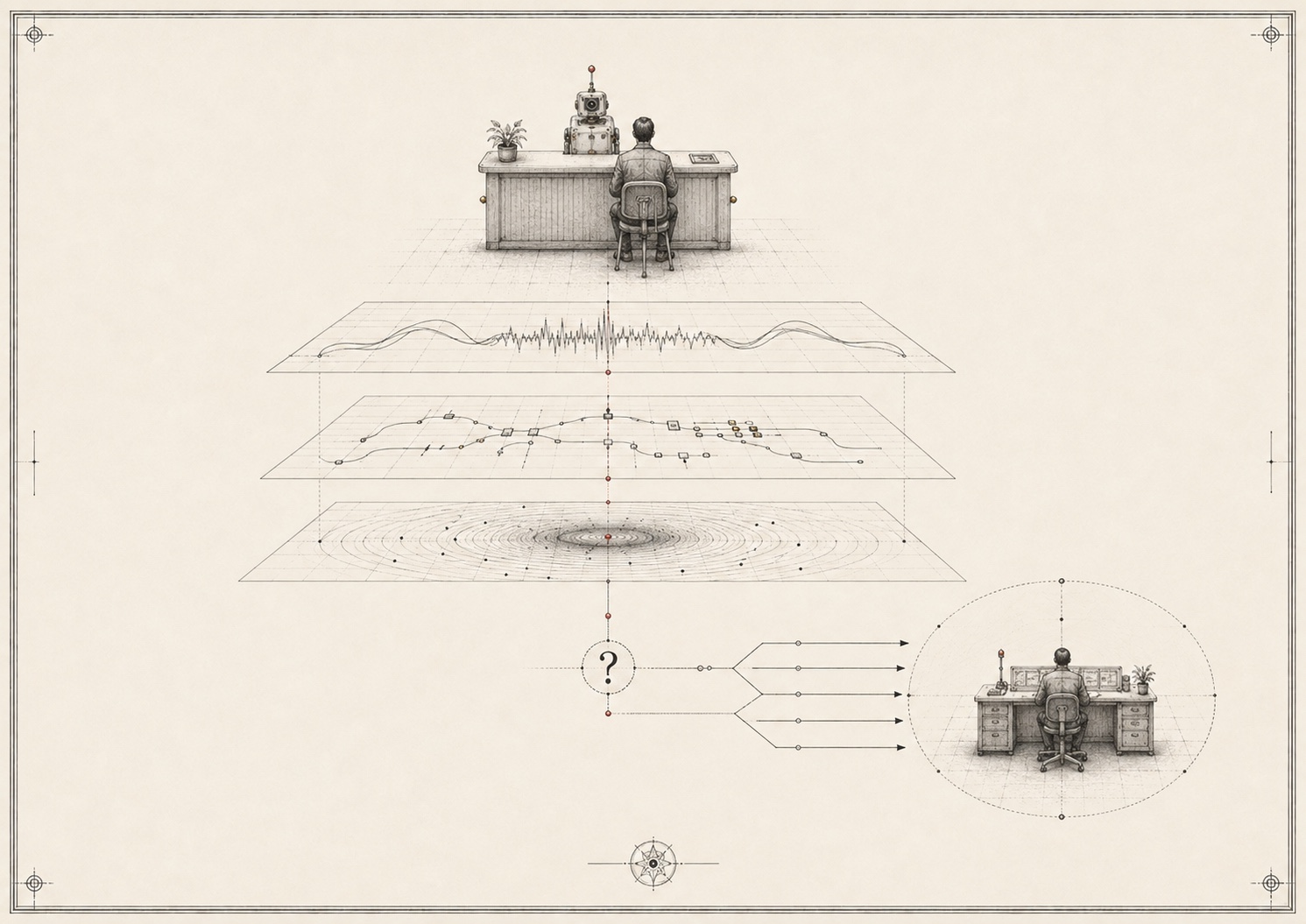
Symbiain is presented as an evolving research architecture. Credibility should come from transparent evaluation, appropriate peer review and retained limitations—not from the visual polish of a prototype.
- 01
Specify
Define the question, baseline, permitted evidence, expected contribution and failure criteria in advance.
- 02
Compare
Test a bounded output against ordinary practice, credible alternatives and expert judgement.
- 03
Challenge
Invite independent researchers and practitioners to identify errors, blind spots and disconfirming cases.
- 04
Publish
Pursue appropriately scoped peer review or conference submission, with methods, limits and corrections visible.
A safe development sequence
Demonstrate value
before granting authority.
- 01
Charter
Define the decision boundary, prohibited actions and named human authority.
- 02
Shadow
Use a permissioned, bounded record to compare with the ordinary workflow without granting the new layer control.
- 03
Compare
Measure it against normal manual handling and retain disagreements.
- 04
Advise
Produce concise evidence cards for human review.
- 05
Intervene
Test one narrow, human-approved action with a safe exit.
- 06
Learn
Review outcomes, false holds, missed anomalies and corrections.
- 07
Scale
Expand only where the benefit and operating boundary are demonstrated.

Retained learning
Do not reward completion
and forget consequence.
A useful learning loop retains the original evidence, the decision boundary, human overrides, near misses, false holds, missed anomalies and the effect of corrective action. Failure remains visible as evidence for revision—not noise to be optimised away.
From one architecture to several fields
Different consequences.
The same discipline.
Accountable action
Evidence, uncertainty, safe holds and human authority.
Open case →02 / INTERACTIONHuman meaning into bounded action
Gesture, language and context without pretending to read minds.
Open case →03 / SERVICEDignified handover
Clarify the situation and transfer sensitive decisions to people.
Open case →04 / AI ASSURANCEFluency is not provenance
Decompose generated answers into inspectable claims.
Open case →05 / CLINICAL RESEARCHKeep judgement professional
Prepare evidence while preserving pharmacist authority.
Open case →06 / CARE SUPPORTContinuity without prediction
Retain what a person said and make uncertainty visible.
Open case →THE NARROWER CLAIM IS THE STRONGER CLAIM
Symbiain is a human-governed research and decision-integrity architecture for making evidence, uncertainty, alternatives, authority, action and correction more inspectable around AI and robotic systems.Discuss a bounded Decision Integrity Review →