This research prototype asks how a decision-integrity layer could make higher-level robotic judgement more inspectable, challengeable and learnable while certified safety control remains independent, deterministic and authoritative.
Casebook / 13
Robotics & decision integrity.
A robot should know when to pause, explain and ask.
When sensors, records and task instructions conflict, how should a robot make its uncertainty, authority boundary and next safe action visible?
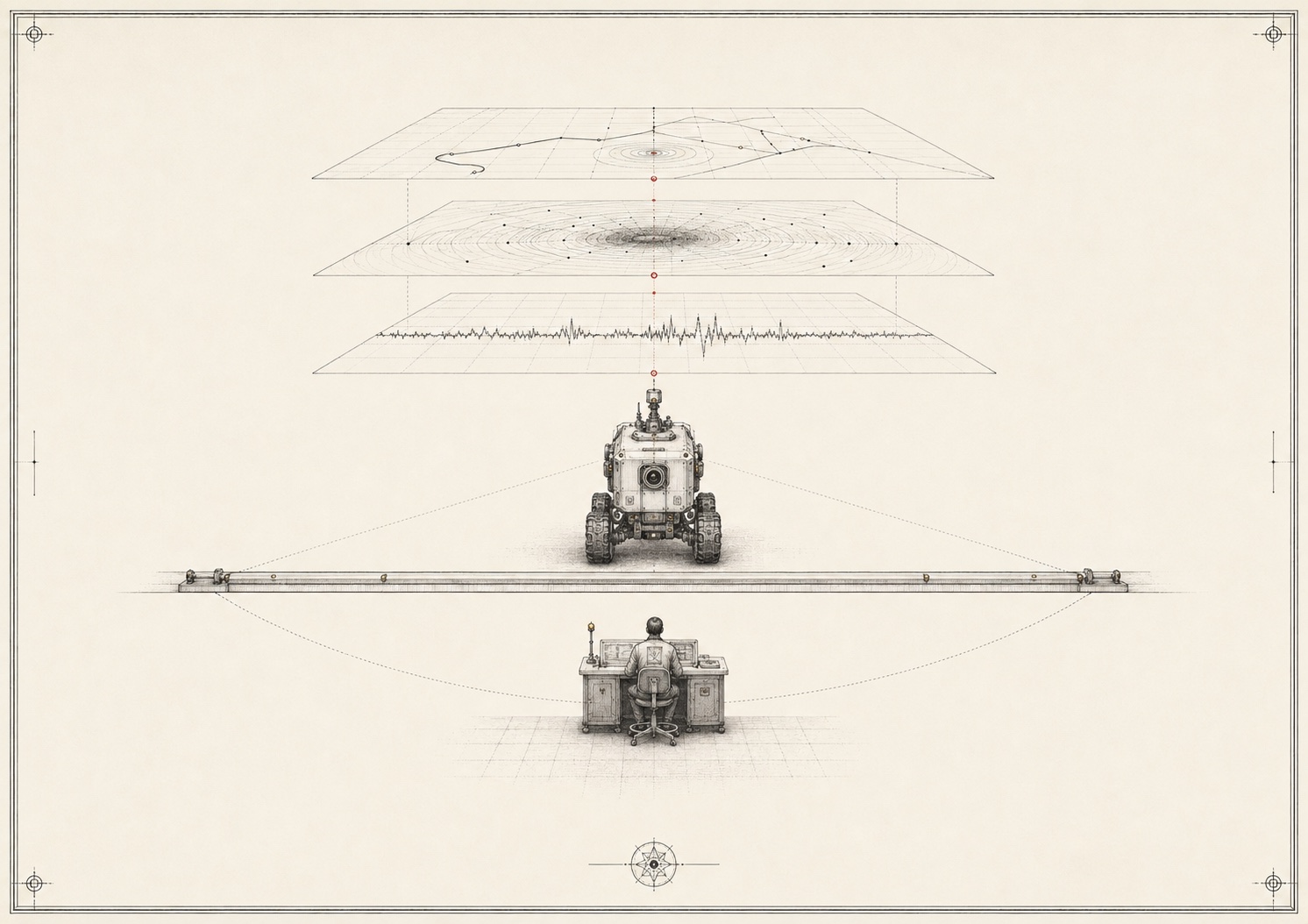
This page demonstrates a way of structuring inquiry. It does not constitute professional advice, verified intelligence, a recommendation or a conclusion about any person, organisation or transaction.
Human-governed application boundary
Clarify the decision.
Do not profile the person.
Any proposed application begins with a named purpose, approved evidence, explicit exclusions and an accountable human decision owner. No ambient surveillance, covert behavioural scoring, mind-reading claim or autonomous consequential decision is proposed.
- 01Bounded purpose
One declared question and stop condition.
- 02Permissioned evidence
Known provenance, access and freshness.
- 03Visible uncertainty
Observation remains distinct from inferred intent.
- 04Human authority
People review, challenge, override and decide.
Visual field plates
Evidence before action.
Authority before automation.
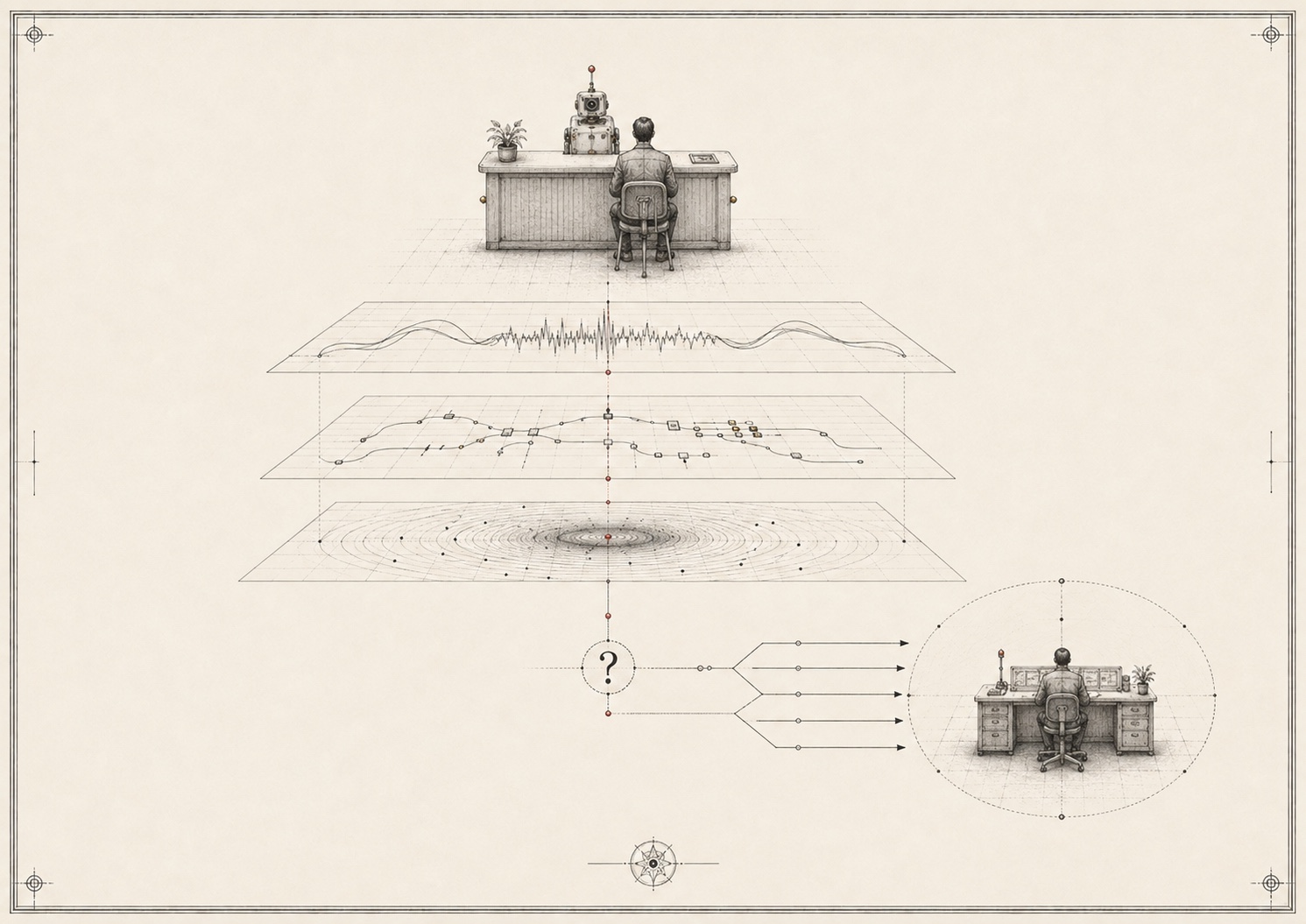
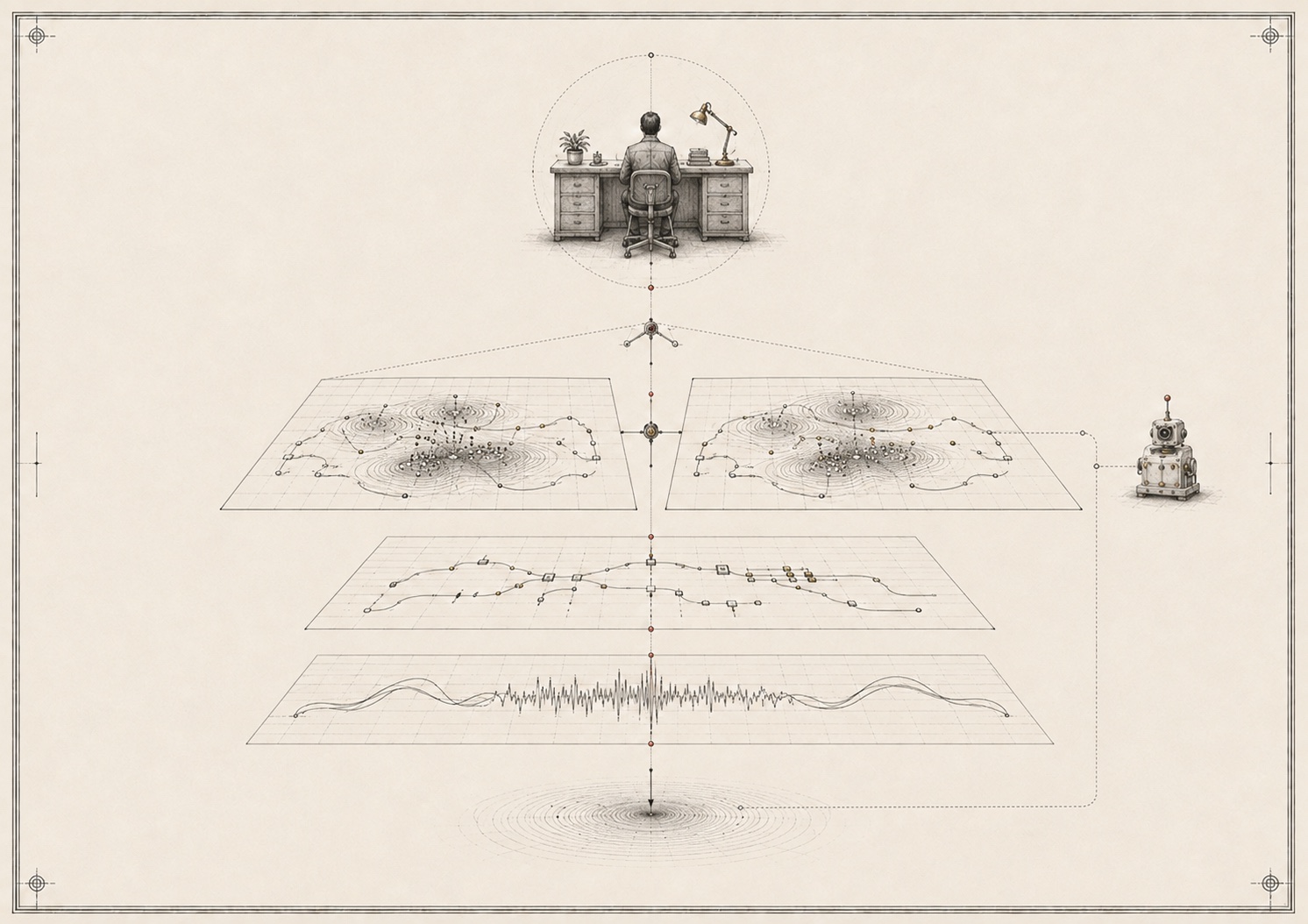
These Field Manual plates make the research proposition visible: what should remain distinct before a system proceeds, holds, explains, hands over or learns? They do not simulate judgement; they preserve context, surface uncertainty and return consequential decisions to accountable human authority.
The case in plain language
Start with the question,
not the answer.
Robots increasingly combine perception, learned planning and language-conditioned task execution in environments where a wrong grasp, route, force or handover can have real consequences. Performance alone does not establish when a system should proceed, re-observe, request approval or hold safely.
The method, step by step
Four moves.
One visible chain.
Symbiain keeps the moves separate: establish what is observed, relate the conditions, test the possible reading, and state what would require revision.
- 01 / Observe
What can we responsibly say?
Industrial-robot safety standards, hazard analysis, engineered interlocks and certified safety functions remain authoritative. Higher-level perception and planning systems can encounter incomplete instructions, degraded sensors, stale records and materially contradictory observations.
- 02 / Relate
What may connect?
Symbiain could operate as a bounded decision-integrity layer around sensing, interpretation, task planning, human handover and learning. Its role would be to preserve the evidence trail, keep observation separate from inference, surface contradiction and uncertainty, and propose a permitted next action—not to enter the real-time control or safety path.
- 03 / Test
What would distinguish the readings?
Against a defined ordinary baseline, does a pre-specified Symbiain-assisted workflow improve traceability, contradiction detection, appropriate escalation, calibration and recovery without eroding certified safety or accountable human authority?
- 04 / Revise
What would change the account?
Advance, simplify or withdraw the proposition according to pre-specified shadow-mode and pilot evidence, including false holds, unsafe recommendations, operator overrides, calibration degradation and independent safety review.
Why use Symbiain here?
From method
to practical value.
The insight is what becomes visible. The feature is what the method does. The benefit is what the user gains. The value is what can improve in the topic at hand.
- 01
Insight
A fluent explanation is not a safe or warranted robotic decision unless it remains tied to the actual evidence, authority and safety state.
- 02
Feature
Creates an evidence ledger, observation–inference firewall, contradiction check, uncertainty service, decision-and-authority gate and outcome-learning register.
- 03
Benefit
Helps an operator see what the robot observed, what it inferred, what conflicts, why it paused and who may authorise the next step.
- 04
Value
Supports more disciplined escalation, handover and incident learning in bounded robotic workflows without claiming autonomous safety or compliance.
What to examine
Five conditions
to hold together.
- 01Independent safety-control authority, certified limits and a no-write boundary into the safety path
- 02Timestamped sources: sensors, maps, instructions, task records, model versions and named approvals
- 03Separation of observed state, inferred state, recommended action and final authorised action
- 04Material contradictions, data freshness, out-of-distribution cues and confidence calibration
- 05Operator overrides, near misses, recovery outcomes, retained failures and controlled revision
Tensions to hold
Operational completion ↔ safe uncertainty
Fluent explanation ↔ evidence-bound rationale
Automation support ↔ accountable human authority
Important boundary
Research-prototype case only. It does not certify a robot, safety system, ISO compliance, clinical use, autonomous capability or performance improvement. Symbiain must not override protective stops, alter certified limits, occupy the real-time safety-control path or displace accountable human and organisational authority. Any real deployment requires competent engineering, hazard analysis, applicable legal and regulatory review, privacy controls, independent assurance and context-specific testing.
Sources & method
Sources support the stated observations only. All analytical readings remain provisional and should be tested against a defined purpose, scope and evidence base.