Representation card
Purpose, scope, version, decision owner, permitted uses and known limits.
Symbiain Artificial Representation / ARS
Symbiain Artificial Representation is an evidence-governed approach developed by Iain Davie.
Symbiain is developing an Artificial Representation System: an evidence-governed architecture for constructing, testing, comparing and revising representations of changing reality.
Artificial Intelligence makes inferences from representations. Artificial Representation governs whether those representations are fit to support inference, judgement and action.
Its discipline applies before, during and after an AI-supported process: frame the situation, qualify the record, challenge the account, and learn from the outcome.
The central proposition
An AI can perform exactly as designed against the representation it is given while being wrong about the situation outside it. The limitation may begin earlier: in a stale record, a missing relationship, a mislabelled category, an untested assumption or a mistaken reading of what an output means.
The Artificial Representation System makes that upstream layer explicit, evidence-bound, challengeable and corrigible before — and after — AI-supported judgement or action.
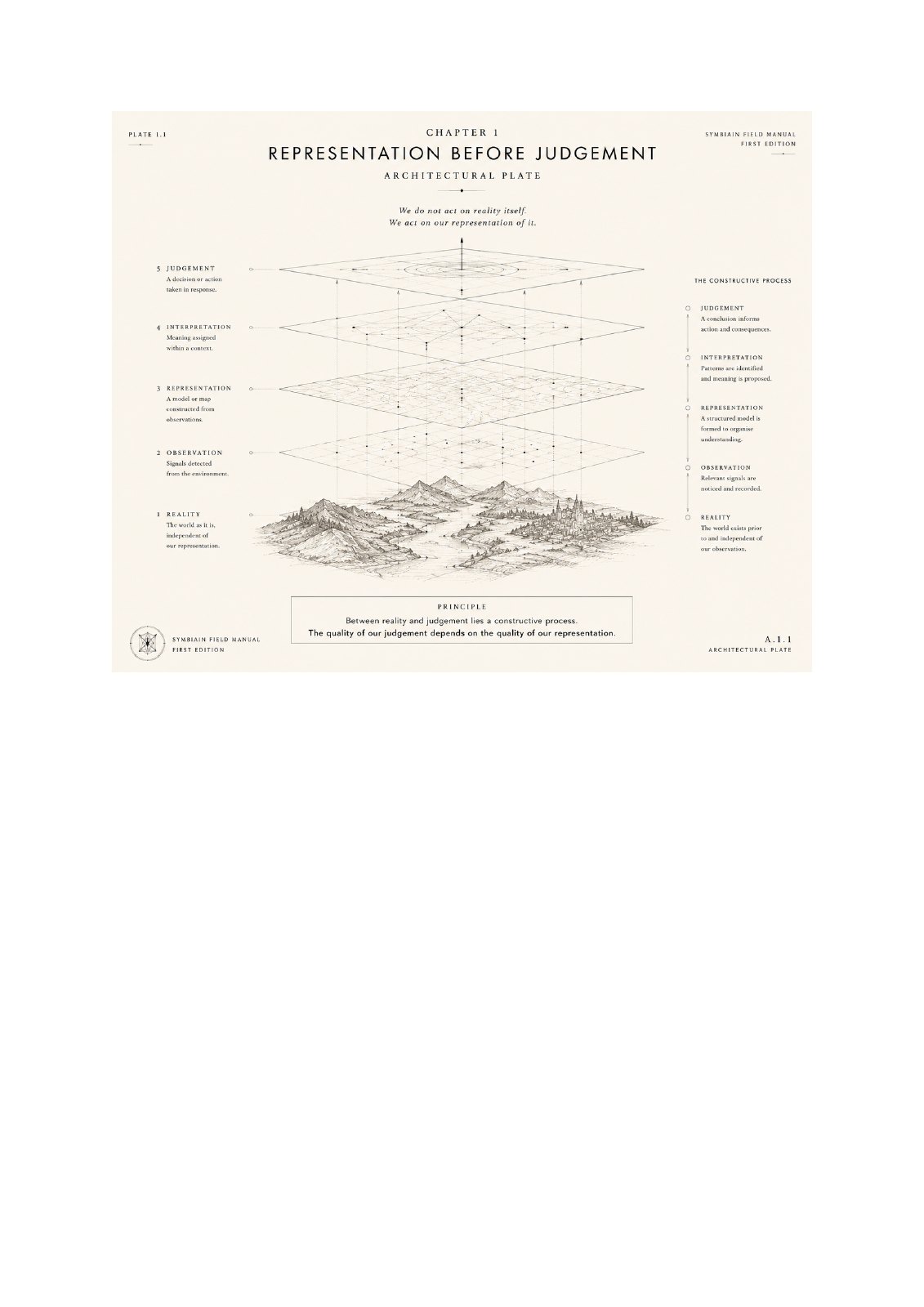
The representational chain
Representational integrity is not a property of a model alone. It is the discipline of retaining the chain from changing reality through observation, framing and representation to inference, judgement, action and outcome.
The changing situation a representation is intended to stand for.
What is sensed, recorded, measured or reported, with source and time visible.
The categories, language, scope, exclusions and transformations used to make a record.
A bounded, versioned account of the situation, its relationships and its uncertainty.
A model, analyst or AI works from that representation; it does not reach reality directly.
Accountable people assess the output, decide what to do and record what happens.
Consequences, contradiction and new evidence test the account and can require revision.
The work upstream of inference
These questions apply wherever a situation is translated into data, categories, language, maps, prompts or model inputs. They are designed to make the basis for an inference available for challenge.
What part of reality is this representation intended to stand for?
Which observations support it, and how current, reliable and complete are they?
What has been excluded, assumed, transformed or inferred?
Which alternative representation could also explain the evidence?
What would show that this representation is wrong or no longer adequate?
Has the outcome supported, complicated or corrected it?
What the architecture makes available
The goal is not to produce an authoritative picture. It is to create an inspectable working account: one that can be compared, challenged and revised as the underlying reality changes.
Purpose, scope, version, decision owner, permitted uses and known limits.
Sources, observations, measurement conditions, provenance, date and reliability notes.
Actors, conditions, dependencies, constraints, pressures and feedback that shape the account.
Alternatives, contradictions, disconfirming evidence and unresolved unknowns.
What changed, why it changed, what outcome followed and what remains uncertain.
Scope and limits
Public materials set out the intended structures and governance boundaries of the Artificial Representation System. They do not establish accuracy, predictive performance, real-world effectiveness or suitability for consequential automated use.
Continue the inquiry
Read the method for the working distinctions, the AI audit for a claim-level application, and the standards for the human authority and correction boundaries that govern practical use.
Apply the architecture