How Chinese philosophy reached Europe—and what changed on the way
The Representation Problem.
In 1687, Jesuit scholars associated with Philippe Couplet published Confucius Sinarum Philosophus in Paris. The Latin volume introduced major Confucian texts to European readers who usually could not check the Chinese originals. It opened Chinese thought to serious consideration—but through translation, commentary and European categories.
How far did European readers encounter Chinese thought—and how far did they encounter a European reconstruction of it?
SYMBIAIN MISREPRESENTATION CASE 001 / WATCH THE EXPLAINER
The Sinarum Transformation.
When readers cannot check the original, they may receive source text and commentary as a single account. The “Heaven” example asks how a Chinese interpretive tradition was presented through European theological categories—and what readers could distinguish.
2 minutes 41 seconds · Archival plates, explanatory diagrams and synthetic British English narration. English captions available in the player.
A substantial Latin presentation of three Confucian texts, published in Paris and closely associated with Philippe Couplet and his Jesuit collaborators. It helped make Confucius more widely available to European readers.
What we investigate
How translation, selection and commentary shaped the Chinese philosophy Europeans believed they were receiving.
1685 / THE CHECKED EXAMPLE
Nathaniel Vincent’s English rendering
A partial English translation of The Great Learning, derived from Prospero Intorcetta’s 1662 Jesuit work. It is related to the same translation tradition, but it is not a quotation from Couplet’s 1687 volume.
What we can inspect
Vincent used “Heaven” where the corresponding Chinese line contains no 天. Zhu Xi’s earlier Chinese commentary does mention Heaven. The evidence distinguishes a short base clause from its interpretation; it does not establish that Vincent invented the idea.
The whole case at a glance
What happened—and how Symbiain helps.
文01 / CHECKED EXAMPLE
One rendering changed the line
Vincent’s 1685 English version includes “Heaven”, absent from the short base clause but present in earlier Chinese commentary.
⌁02 / POSSIBLE MECHANISM
A familiar frame entered
The insertion followed a Jesuit reading that made Confucian morality intelligible through European natural theology.
§03 / POSSIBLE EFFECT
The version could gain authority
Readers inherited the published representation and could treat its framing as source truth.
AI04 / WHY NOW
AI can repeat the pattern
A fluent answer can join true facts with an unsupported word, cause or relationship.
◎05 / SYMBIAIN
Keep every layer visible
Trace each claim to evidence, flag additions and test the judgement before it guides action.
In one sentence: a respected representation can widen understanding while still altering part of its source; Symbiain makes that route inspectable before a later judgement inherits it.
The idea in plain language
Think of a message passed from hand to hand.
Each person tells the next person what they think happened. They may be honest and careful, but their choice of words still shapes the story. After several retellings, the last version may feel like the original even when it is not.
01
Something happens
A text, event, person or system exists in its own setting.
02
Someone describes it
They choose words, categories and emphasis. Some context is retained; some is lost.
03
Others inherit the description
Later readers may know the account much better than they know the source.
04
A judgement follows
Policy, scholarship or action can then respond to the representation as though it were the original.
One real example
Source and commentary can become one account.
Oxford researchers studied an English version of a Chinese sentence made in 1685. The English version added the word “Heaven”. But the Chinese character for Heaven—天—was not in that sentence.
Heaven appears in Zhu Xi’s commentary on this clause, written centuries before the European translations. The question is how the translation combined source wording, commentary and theological interpretation—and whether readers could distinguish those layers.
SOURCE LINE大學之道,在明明德
No 天 in the line.
→ENGLISH REPRESENTATION“Heaven” appears
The reader receives an additional idea about where moral authority comes from.
Why this matters: checking each word is not enough. We must also check whether the added words change the meaning of the whole message.
THE JOURNEY OF AN IDEA
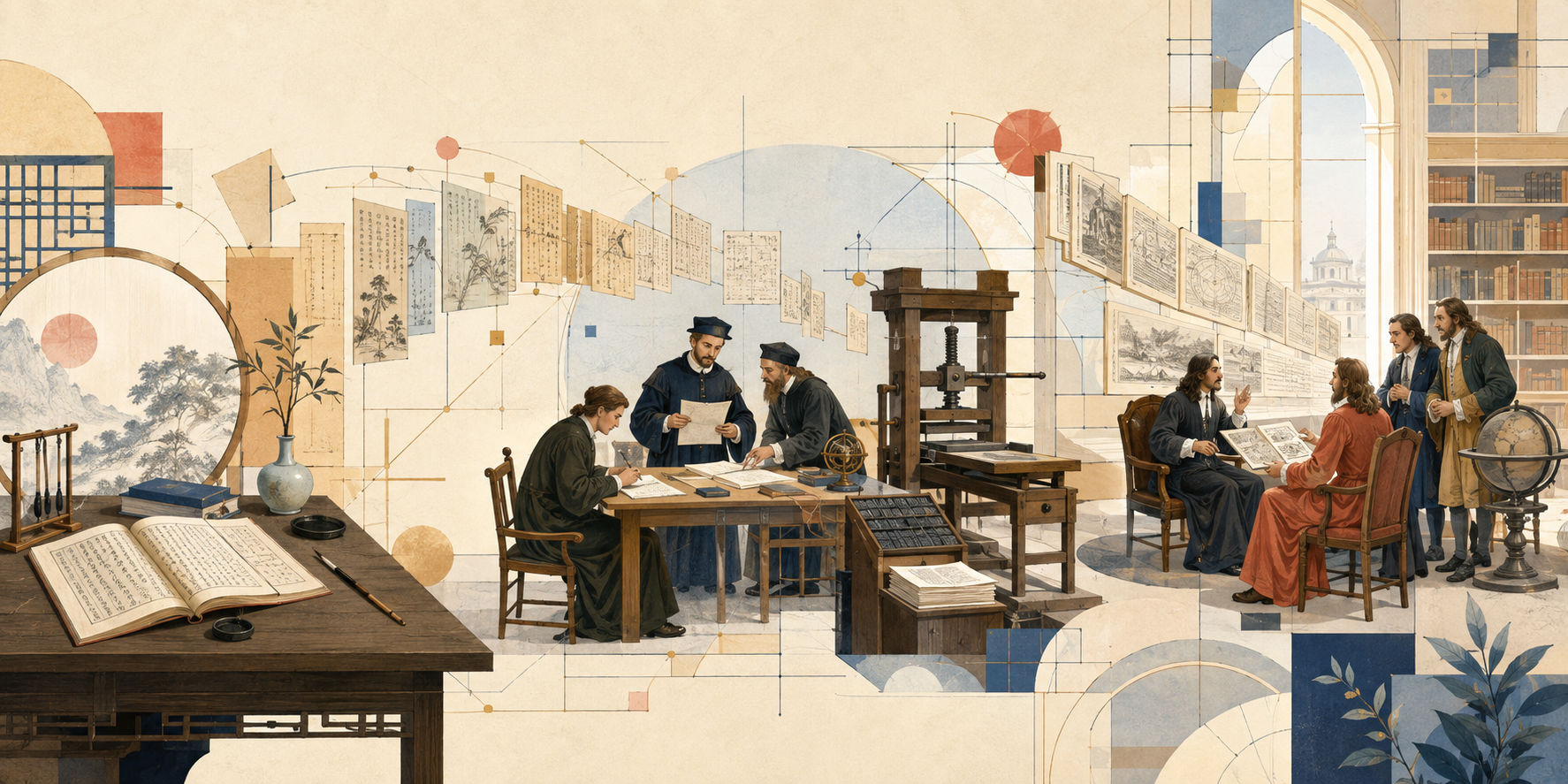
Chinese source → missionary study and translation → European printing → debate among European readers. The illustration shows the route, not a claim that every reader understood the text in the same way.
What happened
How the Chinese text reached Europe.
This story took place before most Europeans could read Chinese. Their first understanding depended heavily on missionaries who had lived and studied in China.
1
The original Chinese teaching
The Great Learning is a short Confucian text about learning, self-cultivation, family, government and social order. Its ideas are connected: improving oneself is linked to creating better relationships and better government.
2
Jesuit missionaries studied the classics
European Jesuits in China learned Chinese and worked with Chinese scholars. They wanted Europeans to take Chinese thought seriously. They also explained it using Christian and European ideas that their readers already knew.
3
The teaching was translated in stages
Prospero Intorcetta published a Latin version in China in 1662. Nathaniel Vincent used Jesuit material for a partial English version in 1685. A larger collective Jesuit production, Confucius Sinarum Philosophus, was published in Paris in 1687 and is closely associated with Philippe Couplet, who carried the project to Europe.
4
Printing carried the European version further
Most European readers met Confucius through these translated and edited books—not through the Chinese originals. The translators therefore became a gateway between the source and its new audience.
What changed in Europe
The books opened new arguments.
The strongest evidence concerns educated European readers, writers and political thinkers. It would be too strong to say that one translation changed all of Western society.
01
Morality beyond Europe
Confucian teaching showed European readers a large and organised moral tradition outside Christianity. That raised a difficult question: could people reach important moral truths through learning and reason?
02
A challenge inside European politics
In England, Vincent used his account of Confucian morality to argue against the political ideas associated with Thomas Hobbes. China became evidence inside a European argument.
03
A model admired by Enlightenment thinkers
Thinkers including Leibniz, Christian Wolff and Voltaire took a serious interest in Confucian ethics and Chinese government. Some treated China—often in an idealised form—as an example of rule guided by learning and moral order.
04
New comparisons—and new simplifications
The translations helped establish the study of Chinese thought in Europe. But they also encouraged readers to fit Chinese ideas into familiar European boxes such as religion, natural theology and enlightened monarchy.
What happened, what it caused, and why
The whole chain— spelled out plainly.
This is the central case. It separates the documented translation problem from the larger historical effects that must be traced with care.
01 / THE SOURCE
The Chinese line made a claim about moral learning.
The source sentence did not contain the character 天, meaning Heaven. Its meaning came from the Chinese words, grammar and intellectual setting in which it was written.
02 / THE CHANGE
An English version added “Heaven”.
That addition did more than make the sentence smoother. It supplied a possible source of moral authority that the Chinese line itself did not name.
03 / THE COMMENTARY
Heaven already appeared in Chinese interpretation.
Zhu Xi’s commentary on the clause refers to Heaven. This predates the European translations. The precise route through Chinese commentary, Latin and English requires further comparison; invention by the European translator is not established.
04 / A POSSIBLE EFFECT
Readers could mistake an interpretation for source data.
If a reader could not check the Chinese, the English wording became their evidence. They could receive source wording and interpretation together, without recognising where one ended and the other began.
05 / THE WIDER EFFECT
The altered representation entered European argument.
Chinese thought became part of debates about morality, religion, reason and government. Where readers relied on translated editions, their opinions could be shaped by the categories those editions supplied.
06 / THE CONSEQUENCE
An inherited interpretation can organise later conclusions.
Once a changed version is printed, quoted and repeated, later writers may inherit it without returning to the source. A small insertion can therefore become part of a much larger picture of another culture.
The received-text problem
An established version can become harder to correct.
Once a representation appears in a respected work, later writers may begin with that published version rather than the original source. Repetition creates familiarity; citation creates authority; neither guarantees accuracy.
01A change enters the representation
An addition, omission or new relationship appears during translation or interpretation.
→02The work becomes established
Publication, institutional standing and scholarly use give the version authority.
→03Later writers inherit it
They quote and reason from the received text, often without returning to the first source.
→04The mindset becomes difficult to change
A correction must now challenge not one sentence, but a network of books, categories and settled expectations.
SYMBIAIN TEST CASE / FUTURE USE
Use the old case to test a modern audit.
This page demonstrates a repeatable capability: separate source from representation, locate an unsupported addition, trace how authority and repetition amplify it, and show which conclusions need to be reconsidered. Applied to a modern AI case, the same method can flag where a generated answer departs from its evidence before that answer becomes the next person’s starting point.
SOURCE→MODEL OR TRANSLATION→CLAIM→DECISION↺ audit every boundary
THE SAME STRUCTURAL RISK, TWO ERAS
Left: a source passes through translation, printing and later reading. Right: source documents pass through an AI system into a human decision. In both pathways, an unsupported addition can become part of the answer unless someone checks it against the source. The scene is an explanatory illustration, not a reconstruction of a named historical room or document.
Why this matters for AI
A confident answer can contain real facts joined by a false bridge.
An AI system can quote genuine sources, use fluent language and still add a connection that the evidence does not support. The seventeenth-century example helps us see why checking isolated facts is not enough.
THEN / TRANSLATION
Source sentence
A Chinese line contains no 天.
→
Added interpretation
“Heaven” appears in English.
→
Inherited judgement
The reader reasons from the altered sentence.
NOW / AI
Source material
Documents contain several supported facts.
→
Generated connection
The model adds an unsupported cause, motive or relationship.
→
Inherited decision
The user reasons from a fluent but partly invented account.
Four checks before trust
1Can every important claim be traced to a source?
2Does the source actually support the relationship claimed?
3Has interpretation been labelled as interpretation?
4What would prove the answer wrong?
Symbiain’s role: keep source, translation or model output, interpretation and final judgement visible as different layers. When a layer adds something, the addition should be flagged—not silently absorbed as fact.
Moneydie, Couplet and the boundary of fiction
Fiction is safest when we know it is fiction.
Both a novelist and a translator build representations. The ethical and intellectual difference lies in what the reader is told—and what kind of truth the work appears to promise.
DECLARED FICTION / MONEYDIE
The construction is visible.
Moneydie presents an invented world through selected scenes, characters and causal connections. The reader is invited to enter that construction as fiction. It may reveal patterns or ask serious questions, but it does not claim that its invented events are a historical source.
Reader’s agreement
“I know this world has been made, and I will judge what it helps me imagine or examine.”
PUBLISHED SCHOLARSHIP / COUPLET’S 1687 GATEWAY
The construction can look like fact.
Confucius Sinarum Philosophus presented Chinese classics through translation, commentary, selection and a European intellectual frame. It was not fiction in the ordinary sense—but neither was it the Chinese source itself, or a neutral pane of glass through which the source could be seen unchanged.
Reader’s risk
“Because this is presented as learned translation, I may receive its framing and additions as statements made by the original source.”
The important distinction
Couplet and his collaborators were not novelists secretly pretending to translate. Their volume was scholarship and mediation—but the published representation must not be confused with the original Chinese text. In the checked 1685 “Heaven” example, the English wording is not a literal translation of the Chinese line: it adds an idea absent from that line. When a scholarly representation makes such a change without keeping it visible, interpretation can be received as source fact. That is the representational problem.
THE TENSION AT THE CENTRE OF MONEYDIE
The novel openly tells the reader that it is fiction, then uses that declared fiction to question a historical representation that carried the authority of knowledge. The fiction does not prove that the published translation was manipulated for control. It makes the hidden construction visible—and asks the documentary record to show what was changed, by whom, for what reason and with what effect.
THE BUTCHER’S SHOP
The Chapter 4 sequence
01 / MANUSCRIPT“His manuscript had been butchered…”
The novel’s fictional Couplet believes that his work has been damaged in Rome.
02 / BLADETing the Chef
The passage turns to the ancient image of a master butcher whose knife follows the natural spaces within what he cuts.
03 / QINGMINGThe butcher’s shop
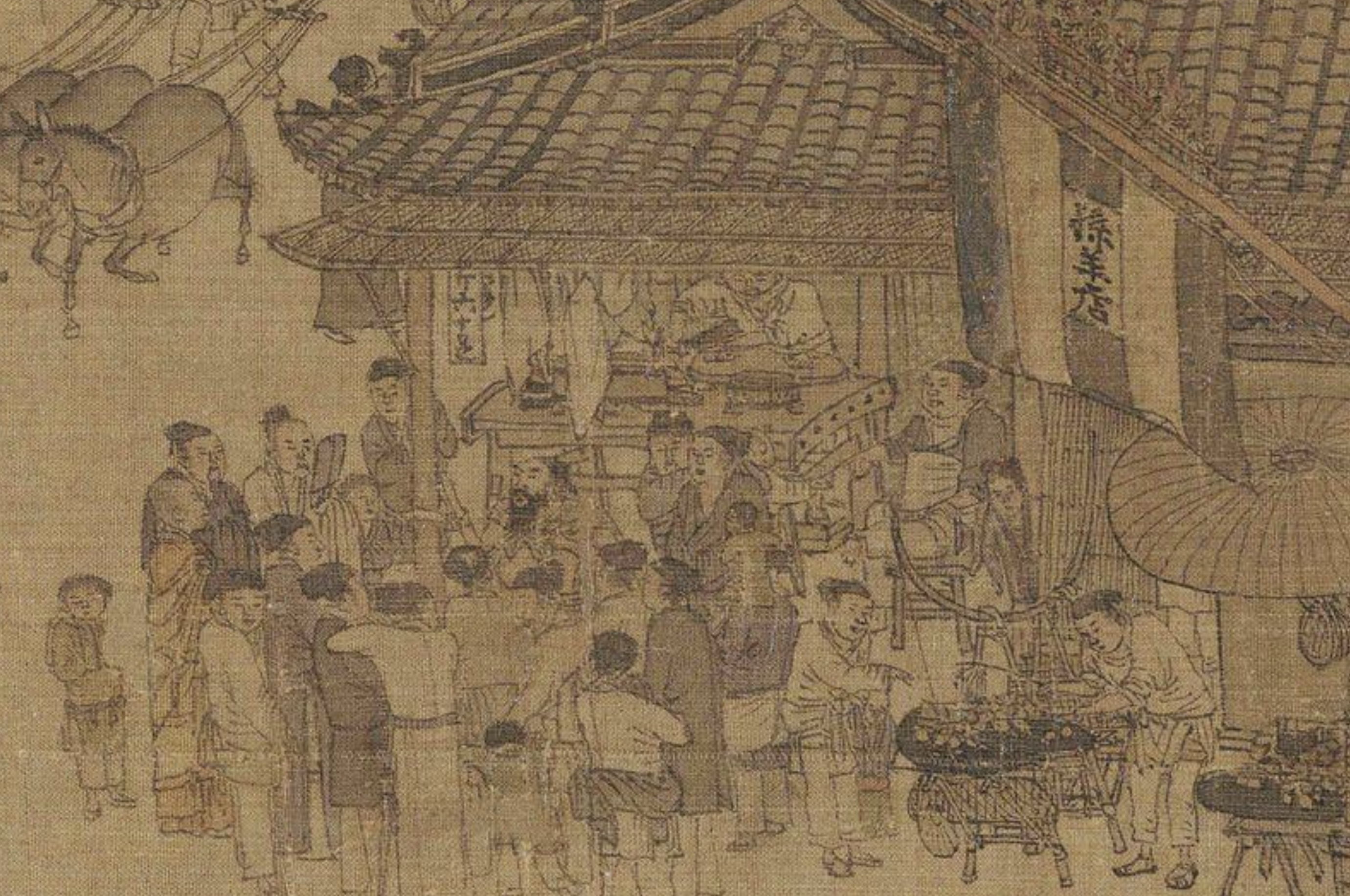
The narrative then reads the shop, carcasses, knife and sharpening child within the Qingming scene as an echo of that concern.
Source boundary
This sequence is cited from Moneydie, Chapter 4. It is a deliberate literary construction by Iain Davie. It explains the felt danger of a manuscript being cut and reframed; it is not a historical statement by Philippe Couplet and does not, by itself, prove what happened during publication in Rome or Paris.
WHAT THE FICTION HELPS US SEE
The metaphor is exact: a skilled cut can preserve a structure, while a blunt cut can damage it. Applied to translation, the question is whether a source was carried across languages with its relationships intact—or cut into a shape that better fitted the receiving culture.
The evidential rule: Chapter 4 gives us the interpretive lens. Historical documents must still establish the editorial decisions, motives and consequences surrounding the real 1687 publication.
FICTIONconstruction+clear label→reader knows
MISREPRESENTATION RISKsource+unmarked addition→reader may not know
THE RESEARCH PROPOSITION
Misrepresentation of reality by institutional design
A source is selected, translated and framed inside an institution; the published version carries authority; later readers treat that version as reality. The mechanism can be observed. Deliberate design, however, must be demonstrated.
The European volume was presented as learned translation and commentary, and it entered debates about religion, morality and government. Publication gave its representation authority; it did not make every interpretive choice identical to what the Chinese source said. The checked insertion shows why the two layers must remain separate.
WHAT STILL REQUIRES PROOF
Was the framing institutionally designed for control?
To establish that stronger claim, the research must rule out simpler explanations and find wider textual patterns plus evidence of intention: instructions, correspondence, editorial decisions, patronage, censorship or a documented strategy—not one altered sentence alone.
A description can miss details, add ideas or connect things in a new way. Later writers often copy the earlier description instead of checking the original.
THE REAL THINGbecomesSOMEONE’S VERSIONwhich becomesTHE NEXT PERSON’S STARTING POINTResearchers can write this more briefly as O → R₁ → R₂.
What we know—and what we do not
Do not mix up facts and ideas.
A fact is something the evidence already supports. A hypothesis is an idea we still need to test. A question is something we do not yet know.
WHAT THE RECORD SHOWS
A book carried Chinese ideas into Europe
Confucius Sinarum Philosophus was published in Paris in 1687. It became an important Latin introduction to Confucian writing for European readers.
A CHECKED EXAMPLE
The added word “Heaven”
Oxford researchers show that an English version from 1685 added “Heaven” even though the Chinese sentence did not contain 天.
AN IDEA TO TEST
Do moving ideas become fixed boxes?
Chinese ideas often describe change, relationships and situations. Did some European translations turn them into more fixed religious or moral categories?
WHAT WE STILL NEED TO LEARN
Did the changed versions shape later thinking?
We need to trace who read these translations, who quoted them and whether the changed ideas appeared in later European writing.
The deeper investigation
Now we look at three things: words, ways of seeing and connections.
You can continue step by step, or move directly to the simple conclusion.
Part I / The translated book
What changed in translation?
We compare the Chinese source with the European version and mark anything that was added, removed or changed.
大學之道,在明明德
SOURCEno 天
→
REPRESENTATION“Heaven” inserted
→
ONTOLOGICAL EFFECTtheological provenance
→
TRANSMISSION EFFECTusable in an English Christian and political argument
A translation can add a new idea even when it looks like a simple copy.
IMPORTANT LIMIT Oxford researchers support this example. It does not prove that anyone deliberately tried to mislead readers.
Sixteen simple checks
A dictionary gives a starting point.
A word can have a history, several possible meanings and a special role in a sentence. These checks help us avoid choosing one English word too quickly.
01Source characters
02Defensible graphic history
03Material or concrete ancestry
04Classical semantic range
05Seventeenth-century plausible register
06Compound behaviour
07Syntax
08Relationship or process encoded
09Translator’s lexical choice
10Information retained
11Information deleted
12Information inserted
13Ontological recoding
14Alternative reconstruction
15Transmission evidence
16Confidence and competing interpretation
How a word develops
A word carries a history.
Take 精 jīng. Earlier uses can connect grain with sorting, refining and removing rough material. That history may help explain later ideas such as purity or concentrated quality. It does not mean that every later use of the character simply means “rice”.
THE RULE A word’s history gives us clues. We must still check how real writers used it in the time and sentence we are studying.
R0 / graphic form
R1 / material association
R2 / process structure
R3 / classical semantic range
R4 / period-plausible register
R5 / conventional translation
R6 / relational reconstruction
Part II / Learning to paint
Learn the rules. Then make them your own.
The Mustard Seed Garden Manual of Painting, known as Jieziyuan, taught painters methods for seeing and making. Its lesson is easy to recognise: practise the method carefully until you no longer need to think about every rule.
欲無法,必先有法
有法之極,歸於無法
法 method→internalisation→mastery→變 transformation→無法 no longer dependent on explicit method
THE SIMPLE IDEA “Method” and “no method” may not be opposites. They may be two moments in learning: first follow the method; later use it freely. We keep other translations open until the evidence lets us choose.
The life between the parts
氣韻生動
This famous phrase is often translated as “spirit resonance” or “vitality”. But a painting may feel alive because its parts work together—not because one object contains a special property called vitality.
CONFIGURATION+RESONANCE→GENERATION→MOVEMENT
PROVISIONAL: “a configuration whose resonant quality generates living movement.”
Words with more than one possible meaning
Do not choose too quickly.
Open a word below to see the meanings a translator may need to compare. The list helps us ask better questions; it does not reveal one secret “true” meaning.
勢 shìposition · configuration · tendency · situational potential · momentum or power
Is force intrinsic, or generated by the configuration?
Semantic range ≠ hidden “true” definition.理 lǐpattern · order · organising grain · philosophical abstraction
When does “principle” convert a pattern into a law-like entity?
Semantic range ≠ hidden “true” definition.法 fǎmethod · model · standard · patterned practice · rule · law
Is the opposition categorical, or a temporal movement through mastery?
Semantic range ≠ hidden “true” definition.氣 qìbreath · vapour · atmosphere · vital-material configuration or activity
What disappears if it is forced into a spirit/matter binary?
What changes when a process is translated as a settled noun?
Semantic range ≠ hidden “true” definition.心 xīnheart · heart-mind · mind
Does a translation introduce a division the source does not require?
Semantic range ≠ hidden “true” definition.
The main idea we are testing
The objects can survive while their connections disappear.
OBJECT-CENTREDOBJECT → PROPERTY
RELATIONALELEMENT A + POSITION + ELEMENT B + TIME → TENDENCY → TRANSFORMATION
A translation might name every visible object correctly but still change how those objects influence one another. We must test this across many texts before treating it as a general pattern.
Part III / Reading a busy city scene
What if the connections are the picture?
The Qingming Scroll shows a busy city. We can list the things in it, or we can follow how people, boats, roads, bridges and trade affect one another. The scroll is older than Jieziyuan; we are comparing ways of seeing, not claiming that one directly caused the other.
CONVENTIONAL INVENTORY
bridge · boats · people · shops · animals · buildings · river
Start with the simplest. Only move up when the evidence supports it.
H0Ordinary differences
Translators naturally choose different words. There may be no larger pattern.
H1Making the idea familiar
A translator uses European categories to help European readers understand.
H2A repeated kind of change
Many translations turn relationships and change into more fixed categories.
H3The changed idea travels onward
Later thinkers read, quote or build on the translated version.
H4Someone changes it deliberately
This is the strongest claim. We must not make it without evidence of intention.
Three-case programme
Translation. Grammar. Relational execution.
I / SINARUM
Semantic transmission
What changed as a Chinese philosophical object passed through Jesuit Latin representation into European intellectual transmission?
II / JIEZIYUAN
Representational grammar
Where does the Chinese visual-theory tradition locate meaning, method and transformation?
III / QINGMING
Representational execution
Can a relational reconstruction expose information hidden by an object-centred inventory?
Source register / current foundation
Trace the inquiry back to its record.
These sources support the page’s documented starting points. The wider semantic corpus, image-rights register, Mai-mai Sze comparison and transmission network remain future research layers.