Cuneiform began with records
More than 5,000 years ago, people in southern Mesopotamia used signs to track goods and rations. The system grew into a powerful way to write many languages.
The history of writing / explained simply
The familiar story is too simple. Babylonian cuneiform did not slowly turn into the letters we use today. Writing developed along several paths. Those paths met, overlapped and sometimes replaced one another.
See the real story in one minute ↓Similar-looking marks do not always belong to the same family. A later system can borrow a material or idea without being a direct descendant.
The answer in one minute
People invented and adapted writing more than once. The important question is not “Which script won?” but “Which script worked for which language, material, institution and task?”
More than 5,000 years ago, people in southern Mesopotamia used signs to track goods and rations. The system grew into a powerful way to write many languages.
The earliest known alphabetic marks appear in Sinai and Egypt. Their makers probably adapted Egyptian signs to represent the first sounds of West Semitic words.
In the first millennium BCE, cuneiform tablets and alphabetic Aramaic writing were both used in the Near East. One did not vanish the moment the other arrived.
Phoenician signs were adapted by Greek writers, then by Etruscan and Latin writers. That is the main route toward the letters used for English today.
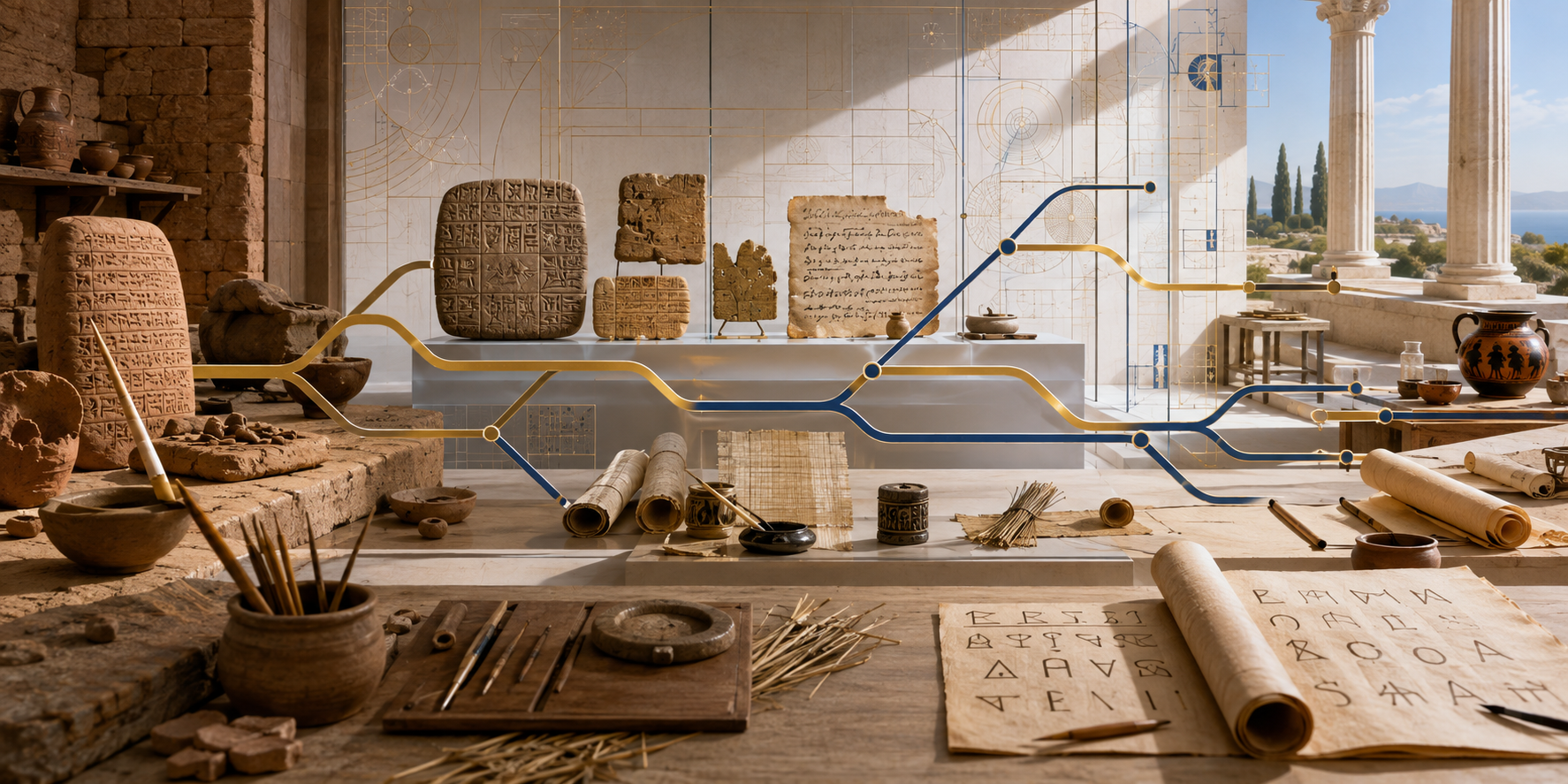
Clay, reed, ink and parchment made different kinds of writing possible. The paths show branching and coexistence—not a claim that every object shown belongs to one direct line of descent. Marks in the artwork are illustrative, not transcriptions of named historical texts.
Part I / Cuneiform
Growing cities needed to remember who received grain, beer, animals and labour. Clay was cheap, local and easy to mark.
Early signs in cities such as Uruk recorded goods and rations. They were not an alphabet and did not work like modern spelling.
Scribes pressed a cut reed into damp clay. Repeated impressions were faster and more regular than drawing curves, creating the wedge-shaped look we call cuneiform.
A sign might stand for a whole word, a syllable or a category clue. This made cuneiform complicated—but also flexible enough to write Sumerian, Akkadian and several other languages.
Scribes trained, copied texts and managed archives. Cuneiform carried contracts, letters, astronomy, medicine, ritual, literature and government for more than three thousand years.
How it worked
Cuneiform was not a single language. It was a writing technology whose signs could work in several ways.
Some signs represented a complete word or concept.
Other uses represented a sound such as a consonant plus a vowel.
A silent sign could help tell the reader what kind of word followed.
Complex does not mean primitive. Cuneiform demanded extensive training, but it supported precise scholarship, administration and creative writing across many centuries.
Part II / The alphabet
An alphabet uses a small set of signs mainly to represent speech sounds. The earliest known alphabetic evidence points toward Sinai and Egypt—not a simple conversion of Babylonian wedges.
A branching chronology
Dates are approximate and scholarly debates remain. The sequence is a guide to relationships, not a claim that one inventor created the whole alphabet.
Early accounting marks develop into a flexible writing system impressed into clay.
The earliest known alphabetic writing appears in a different setting, probably adapting Egyptian signs for West Semitic sounds.
A local alphabet uses wedge-shaped marks. It looks cuneiform because of the tool and clay, but works alphabetically.
A compact consonantal alphabet travels through trade and contact around the Mediterranean.
Greek writers adapt Phoenician signs and use some to represent vowels.
Greek letter forms reach Italy; Etruscan and then Latin adaptations become one major branch of today’s alphabetic world.
Part III / Mesopotamia changes
By the first millennium BCE, alphabetic Aramaic was increasingly useful for communication and administration. Cuneiform continued in scholarship, religion, astronomy, law and other specialist settings.
The change was therefore uneven. Language, script, writing material and institutional authority moved at different speeds.
Tablets could survive fire and burial. Specialist scribes maintained a deep scholarly tradition.
Alphabetic writing travelled through administration and everyday communication, often on materials that decayed.
What the evidence supports
It began before 3200 BCE and remained in use into the first century CE.
In the first millennium BCE, alphabetic systems were used alongside cuneiform in the Near East.
The earliest evidence suggests West Semitic speakers adapted signs influenced by Egyptian writing. Exact dates, places and intermediate steps remain debated.
Because ink writing often disappeared, we cannot simply count surviving objects to measure the social balance between scripts.
Why this belongs in Symbiain
Script, language, material, institution and political authority are connected—but they are not the same thing.
A neat replacement story can hide the long period when several systems served different people and purposes.
Durable evidence can dominate our picture of the past even when fragile media once carried a great deal of communication.
Sources and further reading
These sources support the page’s broad chronology and the distinction between cuneiform, alphabetic origins and later coexistence. The illustration is interpretive and should not be used as an artefact catalogue.
How to write cuneiform
Making cuneiform tablets
The invention and development of the alphabet
Alphabet origins: from Sinai to the Mediterranean
Aramaic in the Achaemenid Empire
The cuneiform world
The simple conclusion