A major printed gateway
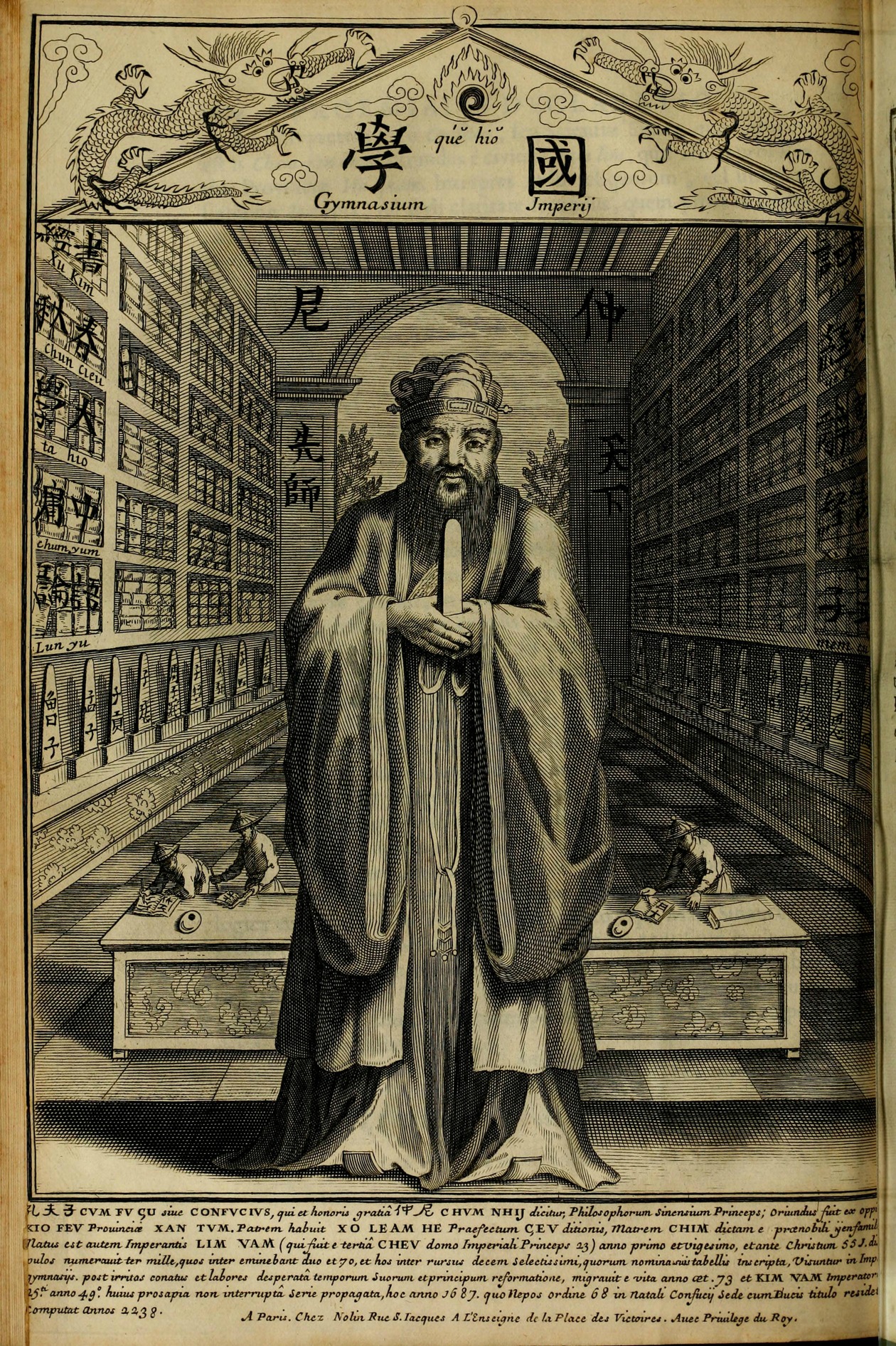
Confucius Sinarum Philosophus appeared in Paris in 1687, a collaborative Latin presentation associated with Prospero Intorcetta, Christian Herdtrich, François de Rougemont and Philippe Couplet. [S02]
Symbiain Misrepresentation Case 001
How Translation Can Preserve the Elements While Changing the Relationships
A text travels. A word enters. A relationship changes. What does the next reader inherit?
01 / Executive intelligence assessment
Confucius Sinarum Philosophus appeared in Paris in 1687, a collaborative Latin presentation associated with Prospero Intorcetta, Christian Herdtrich, François de Rougemont and Philippe Couplet. [S02]
Oxford historian Ross Moncrieff reports “Heaven” in Nathaniel Vincent’s 1685 rendering of a Chinese line without 天. Vincent’s source was Intorcetta’s 1662 Sapientia Sinica. [S01]
Systematic relational loss, centuries of intellectual effects and deliberate manipulation require different evidence. This case offers a testable protocol; it does not claim those findings have been demonstrated.
Misrepresentation does not always replace the facts. Sometimes it preserves the facts and changes the relationships between them.
Governing proposition: a Symbiain analytical claim. The historical evidence below tests particular instances; it does not establish a universal contrast between Chinese and Western thought.
02 / Showcase exhibit
A translation can make explicit a relationship found in commentary but absent from the short source clause.
大學之道,在明明德
Working gloss: the way of great learning lies in making bright virtue manifest.
A modern working gloss for comparison, not a critical translation. There is no 天 in this quoted clause.
“our Spiritual Power conveyed to us from Heaven”
The excerpt adds an explicit source relation: something is conveyed to us from Heaven. [S01]
The parallel marker separates publications. Vincent’s earlier English wording cannot descend from the later 1687 volume.
The lexical absence and reported English wording are inspectable. Zhu Xi’s commentary on 明德 includes 人之所得乎天: Heaven is present in the Chinese interpretive tradition, although absent from this short base clause. [S09] The precise relationship between this commentary and the Latin and English wording still requires collation. The difference alone does not establish distortion or invention by a European translator.
The English passage is verified against published scholarship, not independently collated here against Vincent’s original printed page. Exact Chinese–1662 Latin–1685 English alignment remains a research task. No corresponding 1687 Latin passage is invented or silently substituted.
03 / Element Dice & Slice
Object → representation → structure → relationship → transformation → judgement.
Fix edition, folio, characters, punctuation and surrounding commentary. Keep text and commentary separate.
Record characters, compounds and attested meanings; do not turn graphic components into a translation.
Identify predicates, agents, objects, modifiers, sequence and what remains underdetermined.
Align the Chinese with the Latin or English. Mark additions, omissions, narrowed meanings and changed relations.
Compare independent renderings. Test the strongest charitable reading and passages that resist the hypothesis.
Identify who read which version and how they used it. A translation difference alone cannot prove an effect on later thought.
| Layer | Observation | Assessment |
|---|---|---|
| Elements | Chinese clause: 大學 / 之道 / 在 / 明明德 | Segmentation is analytical; 明明德 also needs grammatical interpretation. |
| Addition | English excerpt includes “from Heaven”. | Reported textual difference; no matching 天 in this clause. |
| Relationship | The English supplies a source for spiritual power. | Symbiain inference about the relation introduced by this wording. |
| Intent | No evidence of deliberate deception presented. | Do not infer intent from the difference. |
| Consequence | Vincent used Confucian material in an anti-Hobbesian setting. [S01] | Local reception context, not proof of centuries of causation. |
04 / Mandarin Semantic Register
“Uncooked” is a metaphor for reopening a compressed translation. It is not a claim to recover a pure meaning hidden inside a character.
The programme retains its working name, Mandarin Semantic Register, but these sources demand historical Literary Chinese, period usage and genre-specific reading. Modern Mandarin glosses cannot supply that evidence by themselves. [S08]
Historical forms; semantic and phonetic components. A prompt for investigation, never proof of contextual meaning.
Material senses attested in dated sources; distinguish documented usage from an appealing origin story.
Candidate actions or transformations. Mark an analytical reconstruction as such.
The lexeme and compound in comparable literary contexts, including counterexamples.
The senses supported in this genre and edition; do not substitute modern Mandarin usage for a Kangxi-period text.
The actual Latin or English wording, its syntax, commentary and interpretive commitments.
Competing contextual readings, ranked by evidence with unresolved ambiguity retained.
05 / A second kind of representation
The Mustard Seed Garden Manual makes a different inquiry possible: how do marks, techniques and arrangements become a teachable representation?
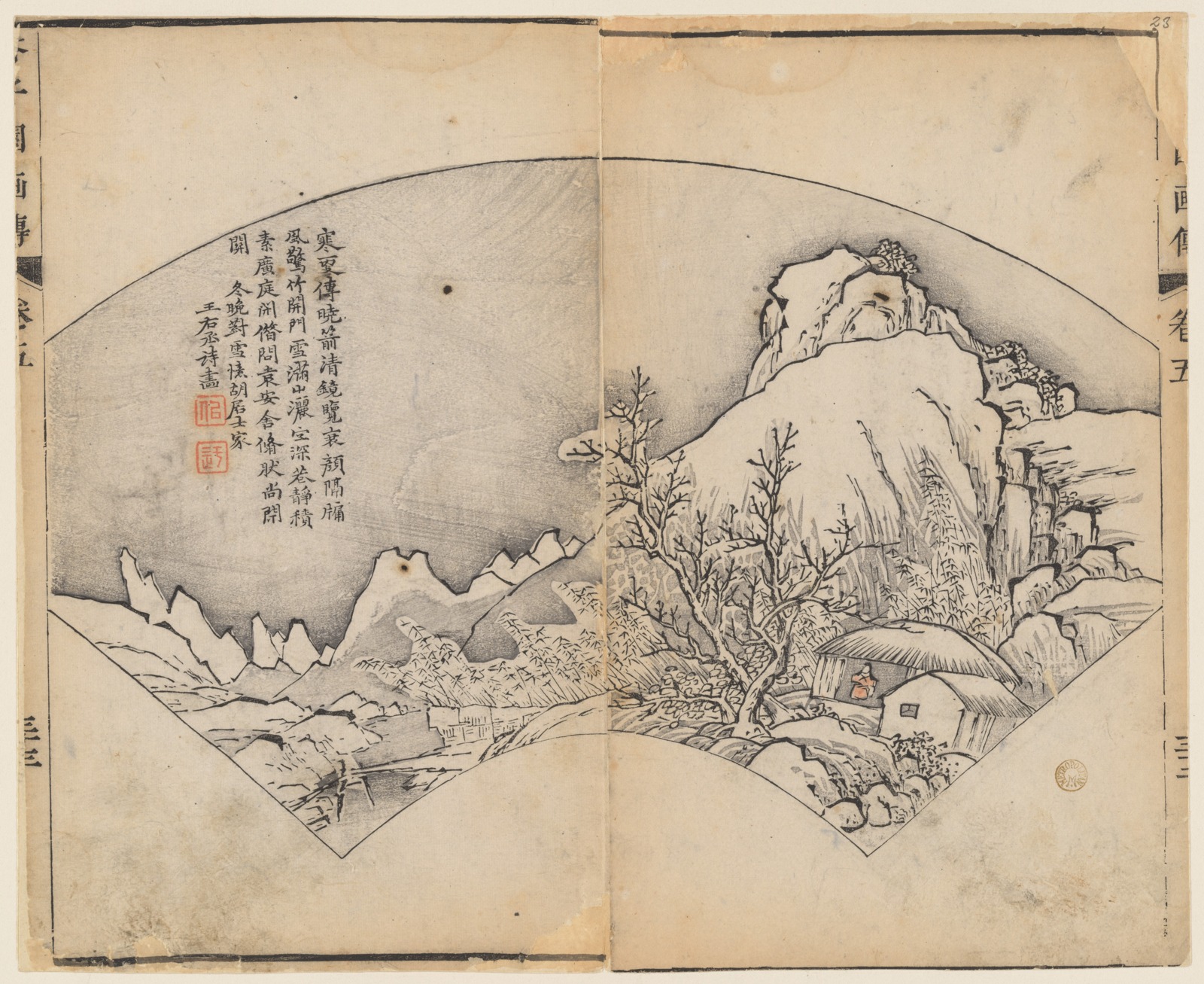
Wang Gai. Woodblock print; ink and colour on paper. The Metropolitan Museum of Art, Rogers Fund, 1924, CP37. Public domain. This sheet provides visual context; it is not the textual page quoted below. [S04]
A plate can be read as an inventory of trees, rocks and water, or examined through placement, scale and relationships. That contrast is a proposed analytical test. The existence of this manual alone does not prove that a relational reading is historically correct.
07 / Semantic choke points
These are research prompts, not dictionary entries or verdicts about a language.
Is an effect attributed to an isolated actor or to an arrangement?
Does the rendering preserve contextual organisation or posit a universal rule?
Does the local passage concern practice, a model, a norm or legislation?
Does the compound require a different reading from either element alone?
Is a process attested by the sentence, or supplied by our analysis?
Does the translation add a mental division or turn coordination into a fixed state?
08 / Comparisons with boundaries
Sze’s translation, first published in 1956, offers a later English comparator. The published facsimile concerns the 1887–1888 Shanghai edition, not an unchanged 1679 witness. [S07]
Align the Chinese passages and edition variants before comparing her choices with alternative readings. Sze is a comparator, not a neutral gold standard or a completed experimental control. No claim of a demonstrated Sze mistranslation is made here.
In a future study, compare object inventories with carefully evidenced spatial and relational readings of the scroll. Record which interpretation changes a judgement, and what visible evidence supports it.
No genealogical claim: similarity would not demonstrate transmission from the later manual to the earlier scroll. This is a comparison across media, not a proposed historical line of descent.
Visit the existing Qingming field study →09 / Sinarum Transformation Hypothesis
These are competing or overlapping explanations, not a ladder on which each step proves the next.
Differences arise from language, genre, commentary and unavoidable interpretation.
Discriminating test: Compare transformations against ordinary translation variation and genuine preservation.
Repeated choices favour categories familiar to the intended European readership.
Discriminating test: Use a preselected Chinese–Latin sample, explicit coding and independent readers.
Theological interpretation changes particular representations of Chinese philosophy.
Discriminating test: Separate a commentator’s gloss from translation and show recurrent effects, not merely religious vocabulary.
Later judgements depend on a transformed representation that readers inherit.
Discriminating test: Join textual transformation to a documented reader, uptake and consequential reuse. Test alternative sources.
A consequential alteration was deliberately designed to produce a particular ideological effect.
Discriminating test: Require attributable archival evidence of that intent. Coherence and missionary affiliation are insufficient.
10 / Strange Signal firewall
Find a reproducible pattern across a defined sample, including negative cases. A compelling exhibit is not a corpus result.
Identify who selected, translated, edited and transmitted the passage. A pattern can emerge without central direction.
Require documentary evidence connecting a particular actor to a particular intended alteration and effect.
No evidence may silently cross this firewall.
11 / Representational path dependence
The text in its edition, language and context.
A translation, selection or commentary.
A later text or judgement based on R₁.
This is an analytical model, not a demonstrated transmission chain for every example in the case. Its central test is whether a later judgement depends on an earlier transformation and would plausibly change if the source relationship were restored.
Companion film / The case explained
When readers depend on a translation, source text and commentary can become difficult to distinguish. Heaven is absent from the quoted clause but present in Zhu Xi’s Chinese commentary. The question is how translation combined those layers and interpreted their meaning. [S09]
2 minutes 41 seconds · Archival plates, original explanatory diagrams and synthetic British English narration. The documented example is separated from provisional interpretations.
Today, Symbiain Intelligence brings together AI-assisted comparison and human judgement to examine how meaning changes as it passes from one account to another. By tracing sources, interpretations and inherited assumptions, we investigate how the accounts we receive shape our understanding.
In sixteen eighty-seven, Couplet and his collaborators published Confucian texts in Latin for European readers. We plan to explore that work in a later film.
Our example here comes earlier. In sixteen eighty-five, Nathaniel Vincent published a partial English translation of the Great Learning, drawing on Intorcetta’s Latin work of sixteen sixty-two. His rendering includes the words “from Heaven”.
The Chinese character for Heaven is absent from the short opening clause being translated. Yet Heaven appears in Zhu Xi’s commentary on that clause, written centuries before the European translations. Its absence from the clause does not mean the idea was absent from the Chinese interpretive tradition.
That distinction changes the question. How were source text, commentary and theological interpretation brought together? What meaning did the translation convey? And could a reader distinguish the original wording from the explanations surrounding it? Symbiain’s role is to make those layers visible: what the source says, what commentary explains, how translation frames it, and what a later reader inherits.
The Mustard Seed Garden Manual opens a related inquiry. Its discussion of method describes learning rules before moving beyond dependence on them.
Mai-mai Sze’s English translation provides a comparison through which Symbiain can examine how those relationships are expressed in another language. Our broader interpretation remains provisional.
When these layers become difficult to distinguish, an interpretation may acquire the authority of the original. Inherited assumptions may then shape thoughts, decisions, behaviour and wider cultural understanding.
Establishing those effects requires evidence at each step.
Symbiain Intelligence helps us trace possible biases, investigate their effects, and recognise when the evidence requires us to correct our own explanation.
Evidence / provenance / open questions
High confidence marks a bibliographic or directly inspectable observation. Documented in scholarship identifies secondary reporting. Provisional marks an interpretation awaiting testing. Not established means this case supplies no adequate proof.
Ross Moncrieff / Oxford Centre for Intellectual History
Secondary scholarship: Vincent 1685, Intorcetta 1662 and English reception. The English quotation is reported here through this source; an edition-and-page collation remains open.
Open the source ↗University of Tsukuba Library
Institutional bibliographic record for the historical object and its named Jesuit collaborators.
Open the source ↗Wikimedia Commons / Internet Archive scan
Plate A: anonymous, 1687. Public domain / Public Domain Mark 1.0. Reduced-resolution reproduction; no inscriptions altered.
Open the source ↗The Metropolitan Museum of Art
Plate B: first edition, printed 1679; woodblock print, ink and colour on paper. Rogers Fund, 1924, CP37. Museum image labelled Public Domain; API confirms isPublicDomain.
Open the source ↗Shidian Guji / 識典古籍
Digital transcription of the primary text. Supports the method/no-method sequence. Facsimile collation remains open; transcription has apparent variants/errors, including 氣運 in its Six Principles passage.
Open the source ↗University Museum and Art Gallery, University of Hong Kong
Institutional source for Xie He’s formulation 氣韻,生動是也. This is not a diplomatic transcription of a specified Jieziyuan edition.
Open the source ↗Princeton University Press / JSTOR
Copyright 1956; facsimile of the 1887–1888 Shanghai edition. Bibliographic comparator; the publisher’s excerpt also supports a sequence of learning rules and subsequently modifying practice. No modern translation pages or illustrations reproduced.
Open the source ↗Stanford Encyclopedia of Philosophy
Methodological context: translation requires interpretation; context constrains meaning. Not evidence that all Chinese thought is relational or all European thought categorical.
Open the source ↗Zhu Xi / Wikisource primary-text transcription
The short opening clause contains no 天, while Zhu Xi’s commentary on 明德 includes 人之所得乎天. This establishes the distinction between base clause and Chinese commentary; it does not establish the precise route into the Latin and English witnesses.
Open the source ↗