This research prototype asks how a decision-integrity layer could make a service robot more attentive to stated context, more honest about uncertainty and more accountable in escalation—without pretending to feel, infer hidden emotion or replace human judgement.
Casebook / 14
Service, dignity & decision integrity.
A service robot should know when to listen, explain, ask and hand over.
When a customer presents an urgent, ambiguous or sensitive problem, what should a service robot retain, explain, ask and transfer to a named human authority?
This page demonstrates a way of structuring inquiry. It does not constitute professional advice, verified intelligence, a recommendation or a conclusion about any person, organisation or transaction.
Human-governed application boundary
Clarify the decision.
Do not profile the person.
Any proposed application begins with a named purpose, approved evidence, explicit exclusions and an accountable human decision owner. No ambient surveillance, covert behavioural scoring, mind-reading claim or autonomous consequential decision is proposed.
- 01Bounded purpose
One declared question and stop condition.
- 02Permissioned evidence
Known provenance, access and freshness.
- 03Visible uncertainty
Observation remains distinct from inferred intent.
- 04Human authority
People review, challenge, override and decide.
Visual field plates
Evidence before action.
Authority before automation.
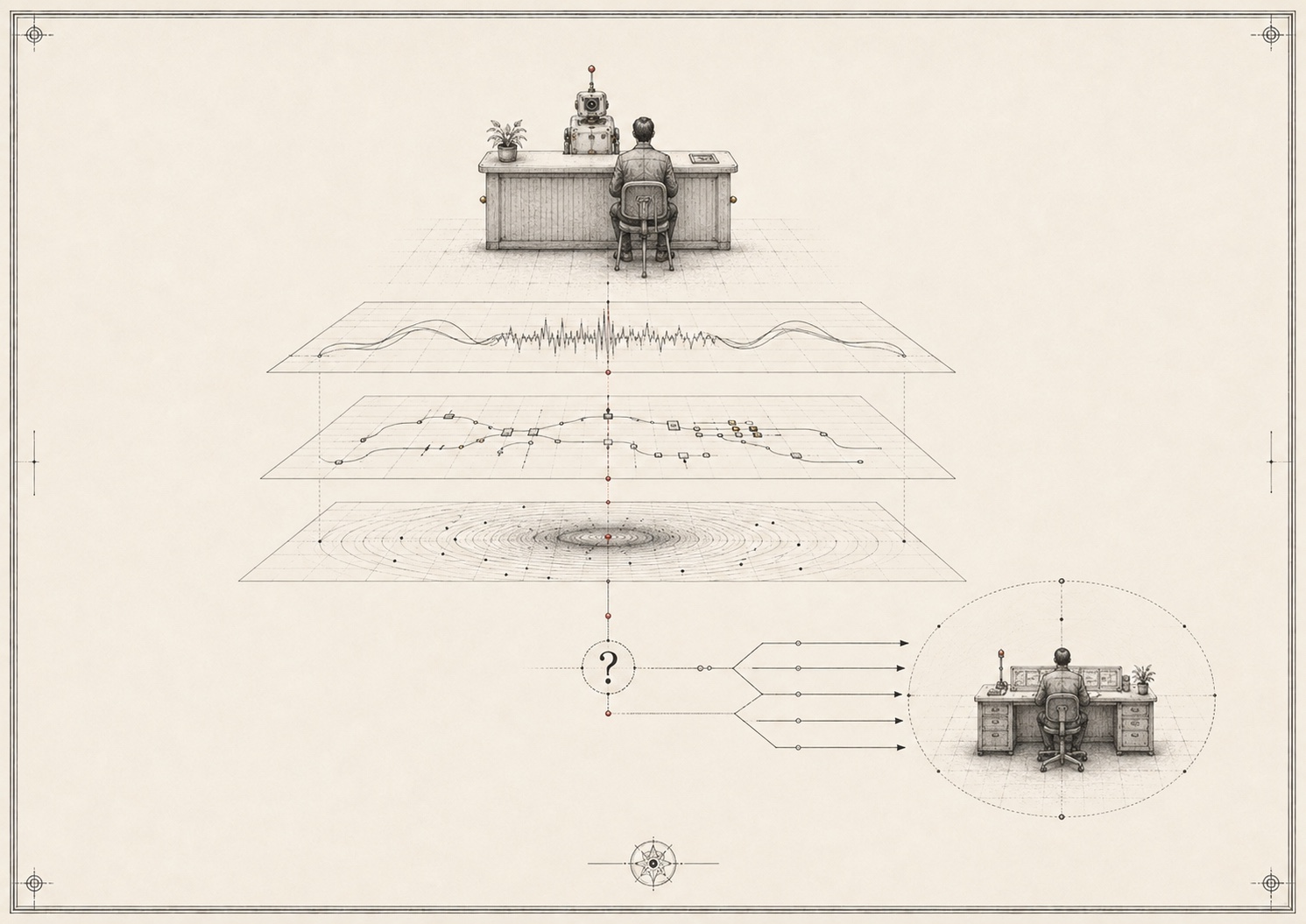
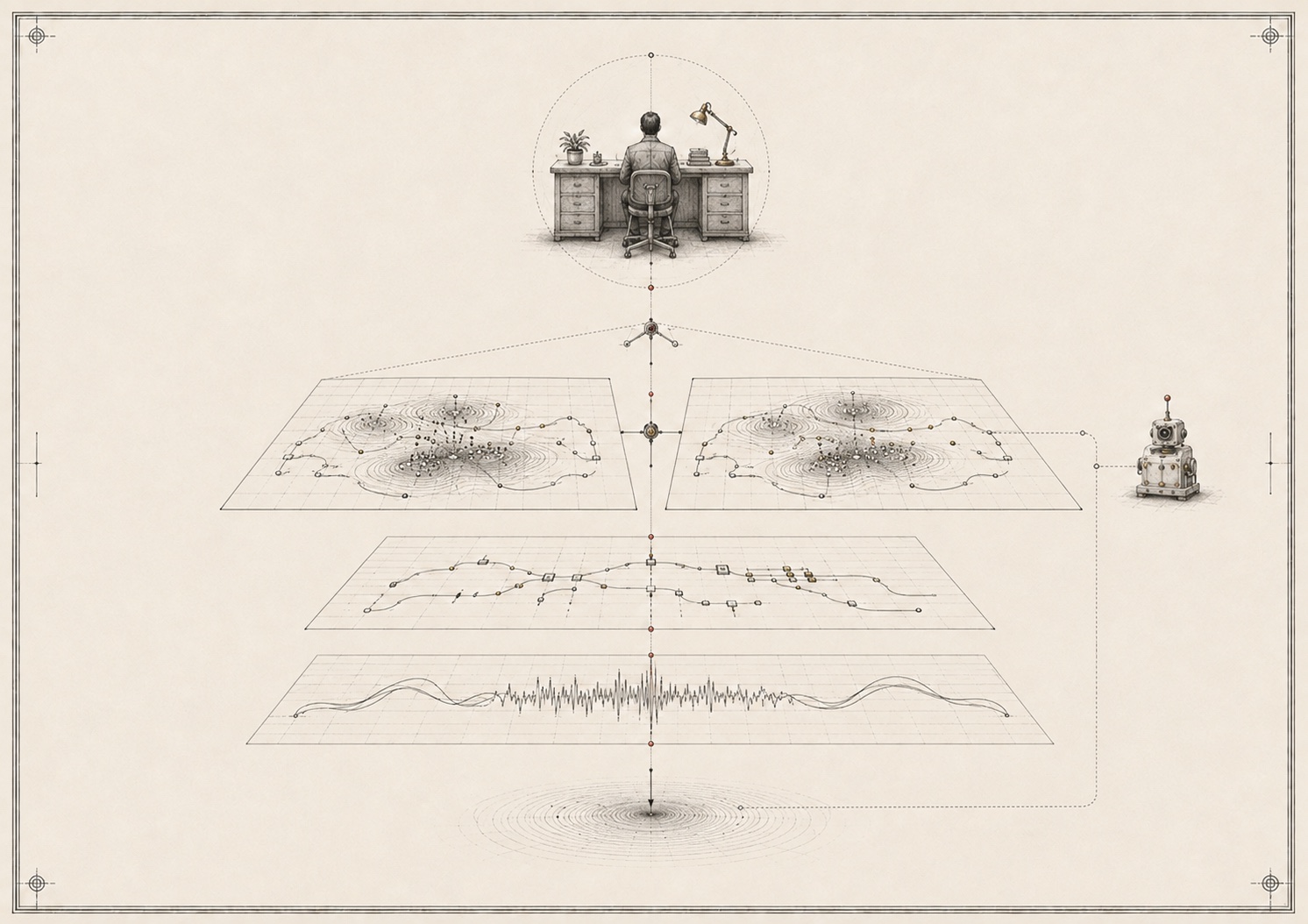
These Field Manual plates make the research proposition visible: what should remain distinct before a system proceeds, holds, explains, hands over or learns? They do not simulate judgement; they preserve context, surface uncertainty and return consequential decisions to accountable human authority.
The case in plain language
Start with the question,
not the answer.
Service systems increasingly mediate access to travel, deliveries, billing, bookings, care-adjacent services and public information. A fluent response is not necessarily a warranted one. Errors arise when a system silently infers need, obscures uncertainty, loses context or acts outside its authority.
The method, step by step
Four moves.
One visible chain.
Symbiain keeps the moves separate: establish what is observed, relate the conditions, test the possible reading, and state what would require revision.
- 01 / Observe
What can we responsibly say?
A customer statement, an account record, a policy, an operational status and a proposed resolution are different kinds of information. They must not be collapsed into an asserted account of what the customer needs, feels, deserves or has agreed to.
- 02 / Relate
What may connect?
Symbiain could provide a bounded decision-integrity layer around service interactions: retain the relevant stated context, distinguish source from interpretation, reveal uncertainty, generate a clarifying question, explain the permitted next step and route consequential or sensitive matters to a named human role.
- 03 / Test
What would distinguish the readings?
Against a defined service baseline, does a pre-specified Symbiain-assisted workflow improve context retention, honest uncertainty, appropriate escalation, explanation quality and correction—without increasing intrusion, manipulation, discrimination or unauthorised decision-making?
- 04 / Revise
What would change the account?
Advance, simplify or withdraw the proposition according to pre-specified trials, including incorrect context retention, inappropriate escalation, missed escalation, customer correction, accessibility impact, privacy findings and independent review.
Why use Symbiain here?
From method
to practical value.
The insight is what becomes visible. The feature is what the method does. The benefit is what the user gains. The value is what can improve in the topic at hand.
- 01
Insight
An apparently warm reply is not considerate service unless it respects the person’s stated account, the system’s uncertainty and the limits of its authority.
- 02
Feature
Creates a bounded interaction record, source–inference firewall, uncertainty statement, question-and-explanation prompt, named handover gate and correction register.
- 03
Benefit
Helps customers understand what the system knows, what it cannot establish, what will happen next and when a person takes responsibility.
- 04
Value
Supports more dignified, legible and corrigible service interactions without claiming artificial empathy or replacing accountable human judgement.
What to examine
Five conditions
to hold together.
- 01The customer’s stated account, recorded without speculative emotional diagnosis
- 02Relevant, permitted account and service context with source and freshness visible
- 03The distinction between known fact, system interpretation and unresolved uncertainty
- 04Clear explanation of the permitted next step, decision owner and handover point
- 05Customer correction, accessibility needs, privacy boundaries and retained service outcomes
Tensions to hold
Fluent assistance ↔ warranted assistance
Context retention ↔ privacy and minimisation
Responsive automation ↔ accountable human handover
Important boundary
Research-prototype case only. It does not claim emotion detection, psychological assessment, therapeutic competence, legal or financial advice, vulnerability inference, autonomous complaint resolution or service-quality improvement. Any real service deployment requires lawful basis, data minimisation, accessibility design, fairness and discrimination testing, security controls, clear customer notice, competent human escalation and context-specific governance.
Sources & method
Sources support the stated observations only. All analytical readings remain provisional and should be tested against a defined purpose, scope and evidence base.