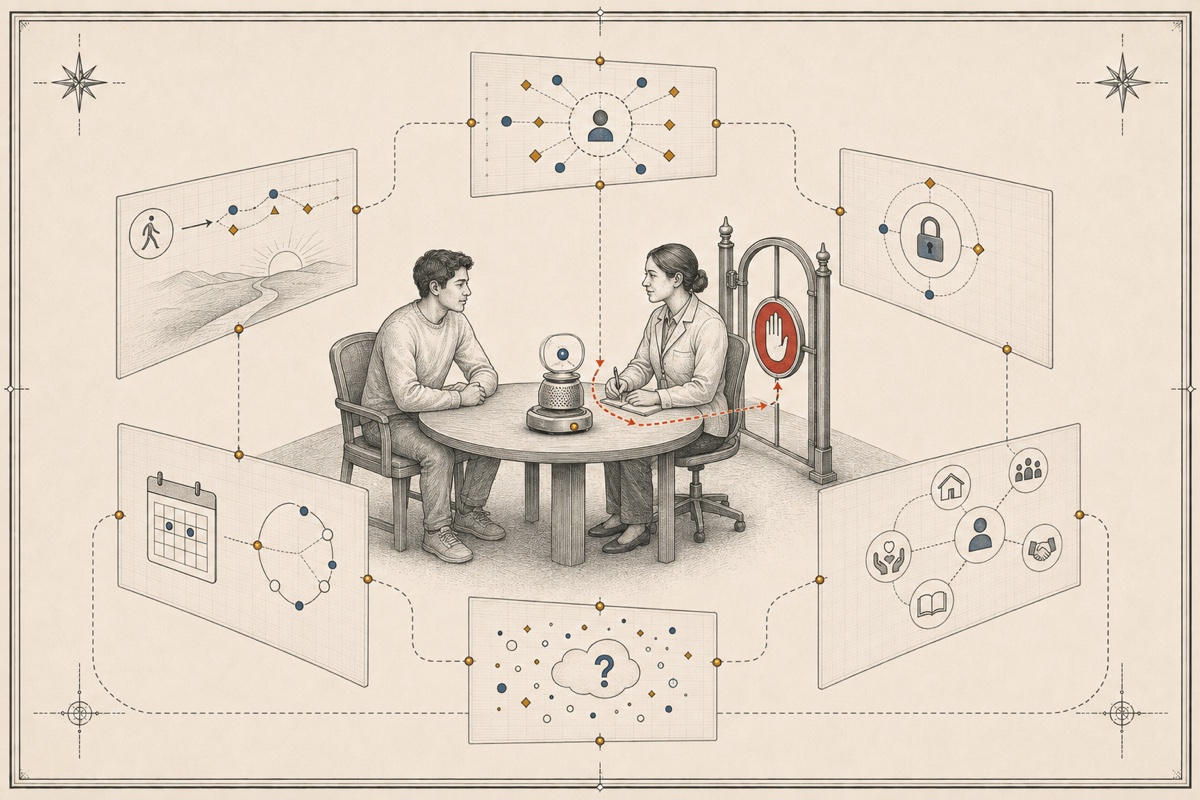
This research prototype asks whether a Symbiain decision-integrity layer could help a drug and alcohol treatment or recovery centre organise agreed, permitted recovery-support information—such as a person’s stated goals, consent choices, appointments, practical support links, open questions and handover needs—while leaving treatment, safeguarding and crisis decisions to trained people.
Casebook / 16
Recovery support & decision integrity.
A support assistant should strengthen continuity, choice and timely human care.
What could a bounded assistant help a recovery team hold together without becoming a counsellor, clinician, case manager or judge of a person’s progress?
This page demonstrates a way of structuring inquiry. It does not constitute professional advice, verified intelligence, a recommendation or a conclusion about any person, organisation or transaction.
Human-governed application boundary
Clarify the decision.
Do not profile the person.
Any proposed application begins with a named purpose, approved evidence, explicit exclusions and an accountable human decision owner. No ambient surveillance, covert behavioural scoring, mind-reading claim or autonomous consequential decision is proposed.
- 01Bounded purpose
One declared question and stop condition.
- 02Permissioned evidence
Known provenance, access and freshness.
- 03Visible uncertainty
Observation remains distinct from inferred intent.
- 04Human authority
People review, challenge, override and decide.
Visual field plates
Evidence before action.
Authority before automation.
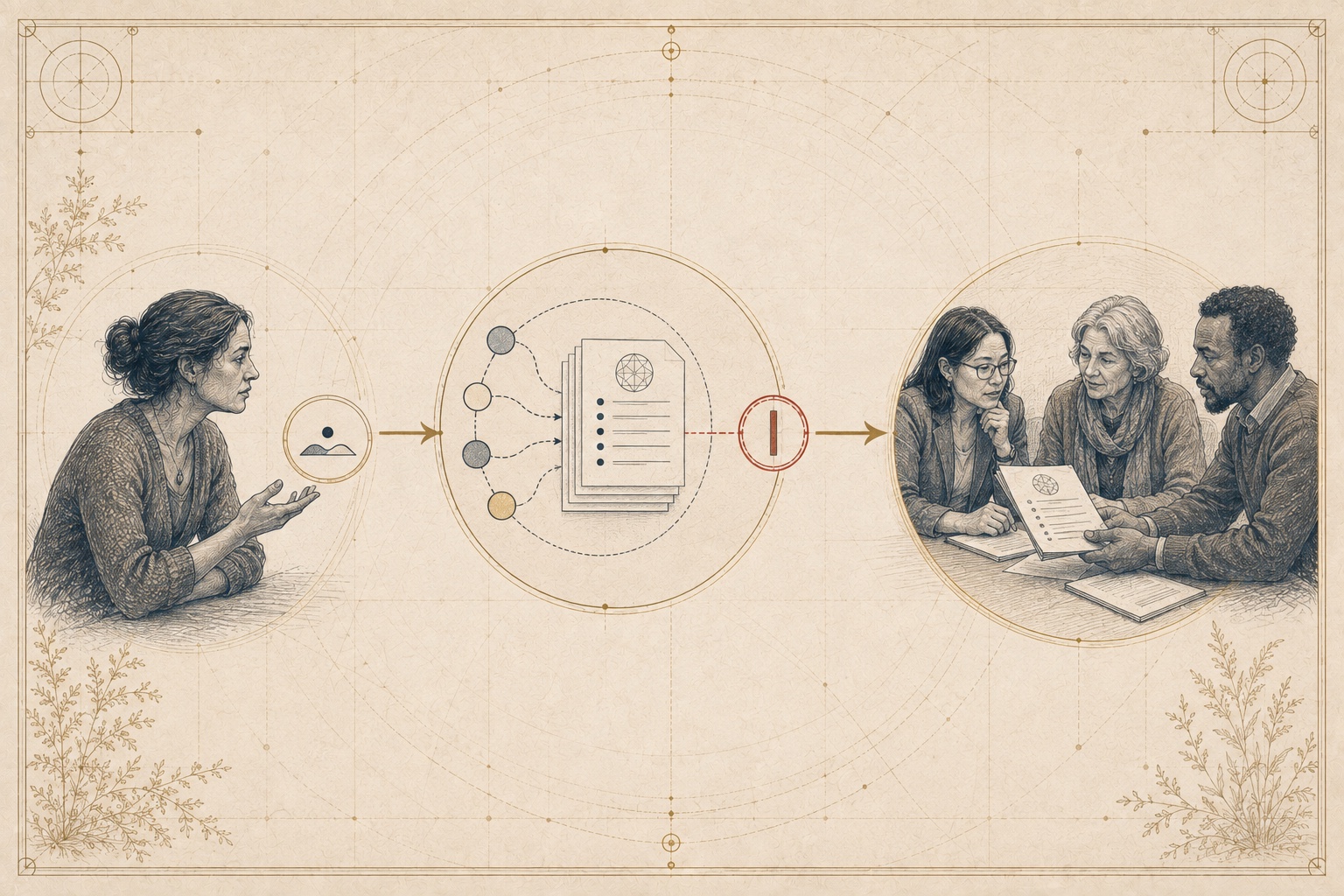
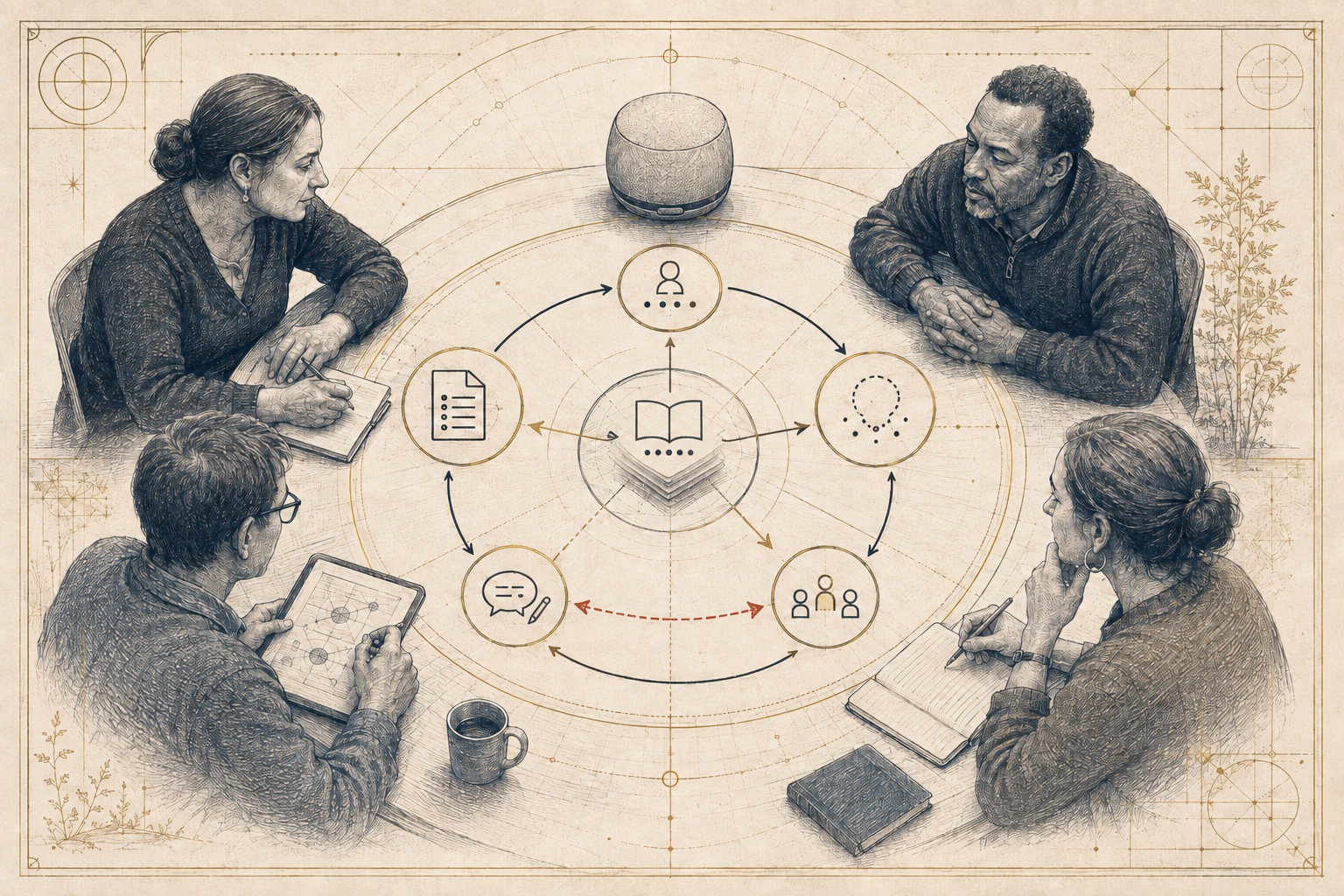
These Field Manual plates make the research proposition visible: what should remain distinct before a system proceeds, holds, explains, hands over or learns? They do not simulate judgement; they preserve context, surface uncertainty and return consequential decisions to accountable human authority.
The case in plain language
Start with the question,
not the answer.
Continuity can be lost when people repeat their account, transfers are incomplete, records become stale, practical barriers are unseen or staff lack an agreed picture of what has been consented to. A digital assistant cannot establish need, motivation, safety or clinical suitability; it can only organise permitted information, show gaps and prompt a person with authority to review.
The method, step by step
Four moves.
One visible chain.
Symbiain keeps the moves separate: establish what is observed, relate the conditions, test the possible reading, and state what would require revision.
- 01 / Observe
What can we responsibly say?
A person’s own account and goals, consent, active support plan, named workers, appointment status, practical needs, family or carer involvement and safeguarding information are different kinds of record. They have different owners, confidentiality boundaries, freshness rules and consequences.
- 02 / Relate
What may connect?
Symbiain could sit outside therapy, diagnosis, prescribing, assessment, crisis response and formal safeguarding decision-making as a bounded continuity layer. It may make permitted support information more legible, distinguish stated context from system interpretation, identify a missing handover or expiring consent, and route any concern or uncertainty to the named trained human role. It must not infer relapse risk, vulnerability, deception, emotional state or treatment need.
- 03 / Test
What would distinguish the readings?
Against an ordinary, non-AI continuity baseline, does a shadow-mode workflow improve consent visibility, respectful handover, appointment and support-plan continuity, appropriate escalation and correction—without increasing surveillance, stigma, data misuse, automation bias or loss of therapeutic relationship?
- 04 / Revise
What would change the account?
Advance, change or withdraw the proposition only via pre-specified, independently reviewed evidence: unwanted data retention, inappropriate or missed escalations, staff or service-user corrections, privacy incidents, accessibility and equity impacts, disengagement, safeguarding concerns and retained failure records.
Why use Symbiain here?
From method
to practical value.
The insight is what becomes visible. The feature is what the method does. The benefit is what the user gains. The value is what can improve in the topic at hand.
- 01
Insight
A support record is only helpful when the person’s stated account, consent, uncertainty and human responsibility remain visible.
- 02
Feature
Creates a permitted-information register, stated-context boundary, consent-and-freshness prompt, continuity and handover check, human-authority gate and correction record.
- 03
Benefit
Helps staff and peer-support teams see what has been agreed, what may be out of date, where a handover is incomplete and who needs to review the next step.
- 04
Value
Provides a research framework for testing whether careful coordination can strengthen continuity and dignity without turning recovery support into automated surveillance or clinical judgement.
What to examine
Five conditions
to hold together.
- 01The person’s stated goals, preferences and consent, with clear scope, expiry and withdrawal routes
- 02Named responsible worker, peer-support role and agreed human handover route
- 03Permitted records, source provenance, freshness and minimum-necessary information
- 04Appointments, practical-support connections and transfer points with no inference about motivation or risk
- 05Uncertainty, corrections, privacy concerns, accessibility needs and evidence that the system should pause or be changed
Tensions to hold
Continuity ↔ confidentiality and data minimisation
Helpful reminder ↔ surveillance or pressure
Automation support ↔ person-centred human relationship
Important boundary
Research-prototype case only. It is not therapy, counselling, case management, diagnosis, clinical assessment, detoxification guidance, relapse prediction, vulnerability detection, crisis response, safeguarding assessment, treatment recommendation or medical advice. It makes no claim of recovery outcome, safety, staff-productivity or risk-detection improvement. Any real use would require co-design with people with lived experience, qualified treatment and recovery staff, clear lawful basis and consent, data minimisation, safeguarding governance, accessibility and equity review, local assurance, training and independently reviewed context-specific evaluation.
Sources & method
Sources support the stated observations only. All analytical readings remain provisional and should be tested against a defined purpose, scope and evidence base.
- NICE — Drug misuse in over 16s: psychosocial interventions ↗
- WHO and UNODC — International standards for the treatment of drug use disorders ↗
- GOV.UK — Confidentiality guidance for drug and alcohol treatment providers and clients ↗
- NHS England — Drug and alcohol treatment and recovery workforce capability framework ↗
- Symbiain — Method and decision-integrity discipline ↗