This research prototype asks whether Symbiain can help a pension governing body see liabilities, member interests, covenant, strategy, managers, underlying assets, liquidity, costs, stewardship and outcomes as one inspectable field while every regulated and fiduciary decision remains with the responsible people.
Casebook / 17
Pension stewardship.
See through delegation without losing responsibility.
Can trustees see how delegated decisions, underlying exposures and changing conditions affect the scheme’s ability to serve members?
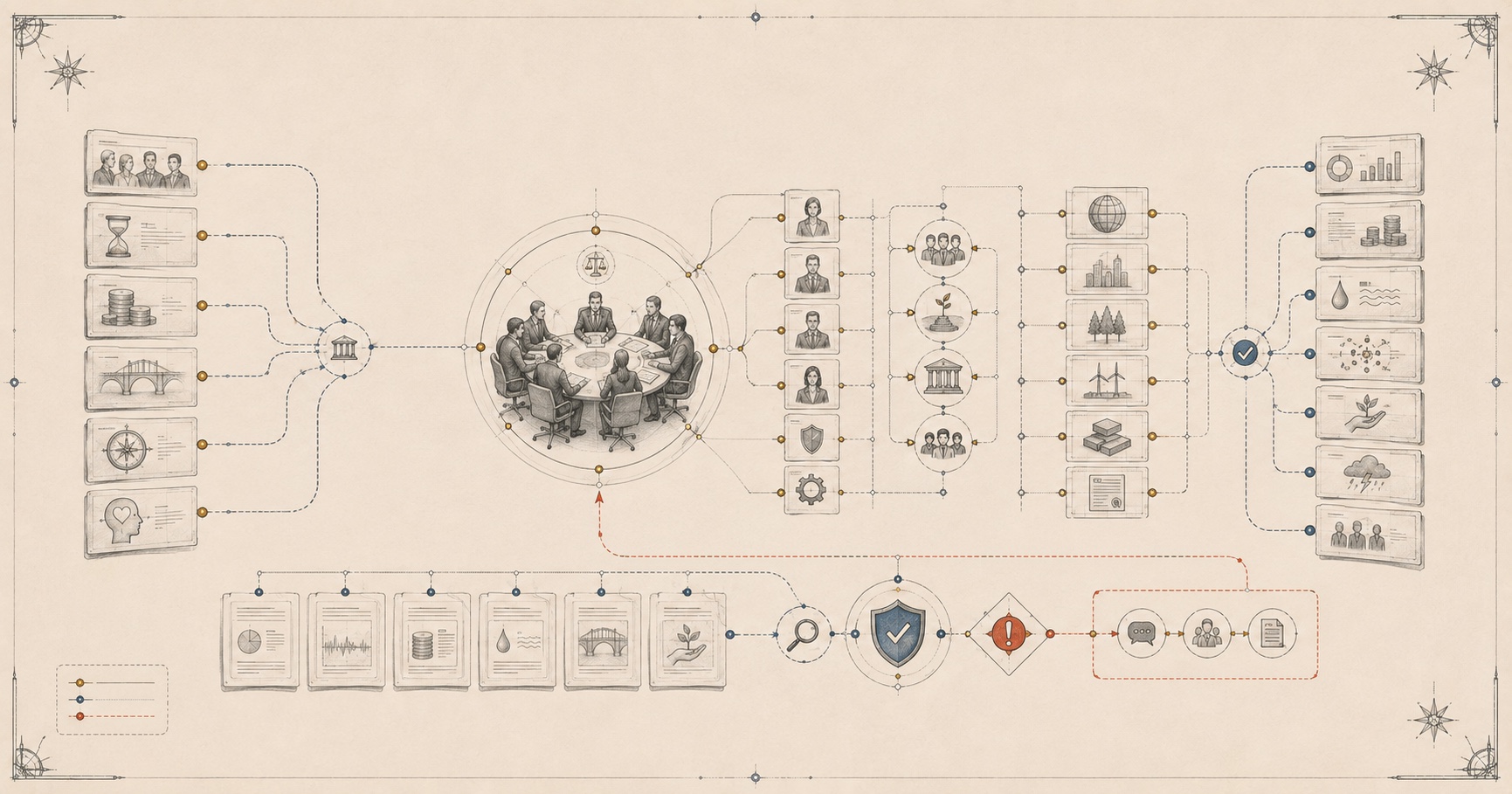
This page demonstrates a way of structuring inquiry. It does not constitute professional advice, verified intelligence, a recommendation or a conclusion about any person, organisation or transaction.
Visual field plates
Make the field visible.
Keep the claim bounded.
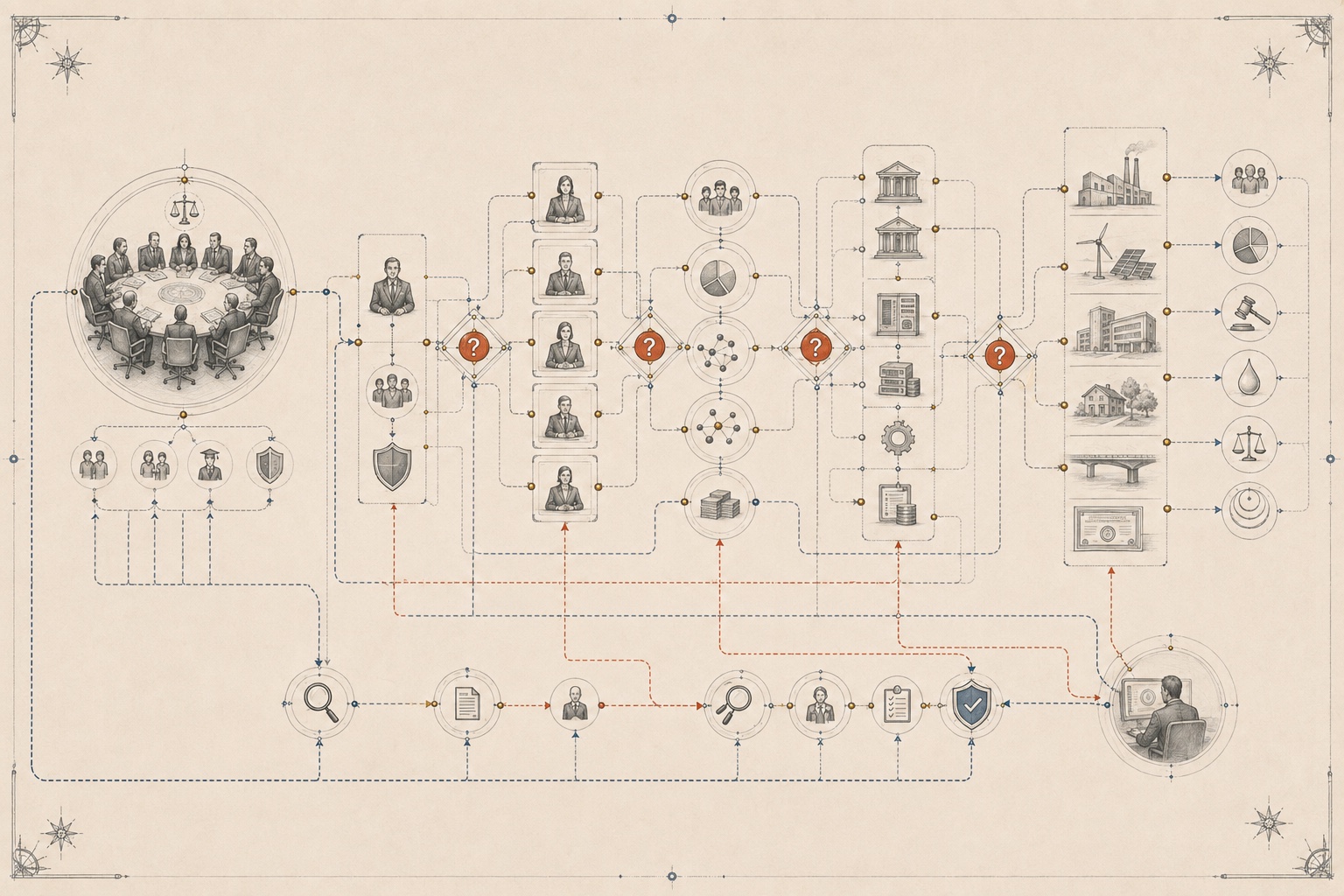
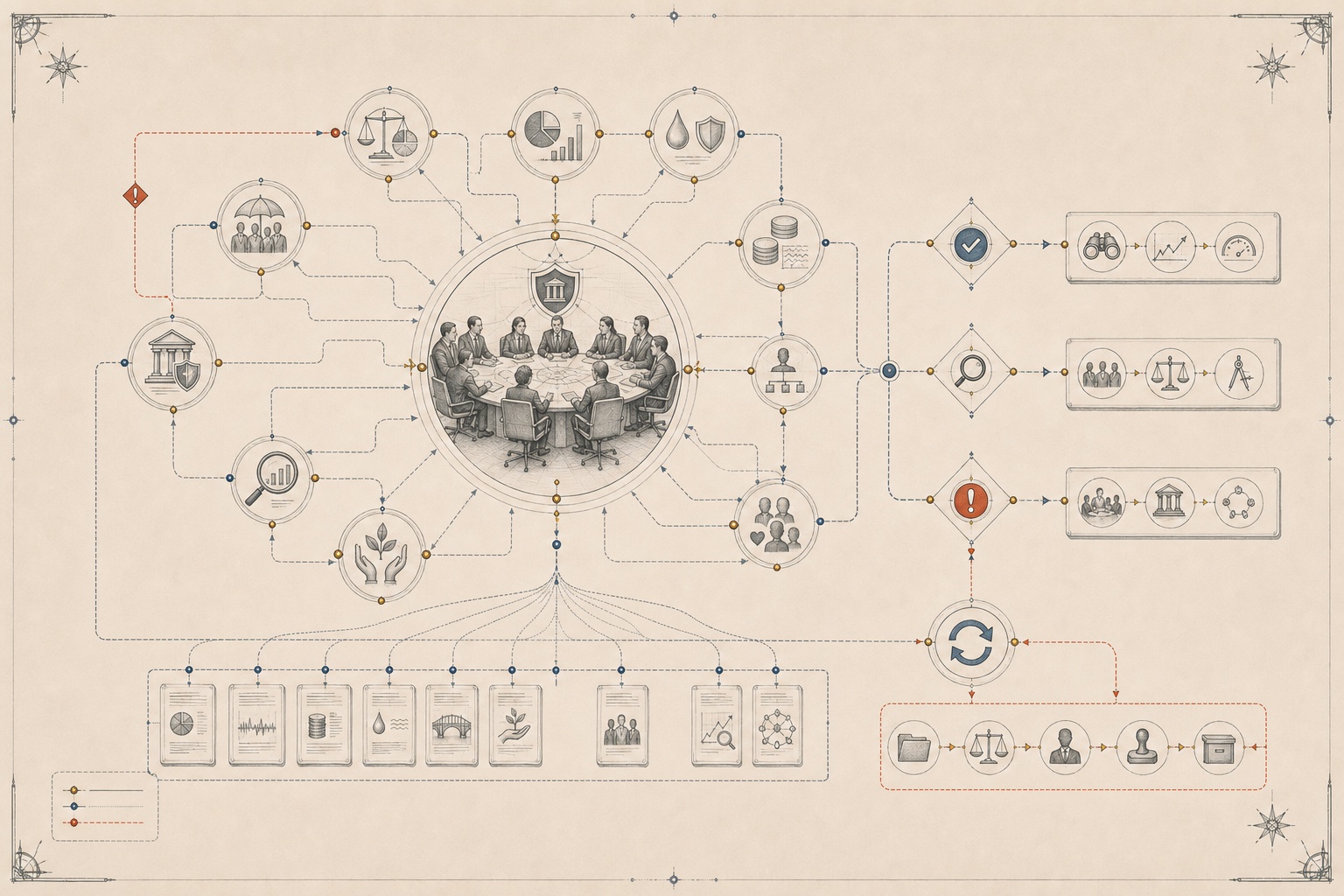
These original editorial plates are analytical aids, not source evidence or documentary reconstructions. They show what is being compared, where uncertainty sits and what observation would require the account to change.
The case in plain language
Start with the question,
not the answer.
Reports from advisers, managers, custodians and service providers may each be useful while still leaving the interactions among obligations, exposures, liquidity, concentration, costs and member outcomes hard to see. Delegation changes who performs a task; it does not remove the governing body’s need for effective oversight.
The method, step by step
Four moves.
One visible chain.
Symbiain keeps the moves separate: establish what is observed, relate the conditions, test the possible reading, and state what would require revision.
- 01 / Observe
What can we responsibly say?
The Pensions Regulator describes investment governance as scheme-specific policies and procedures, expects governing bodies to understand their powers and responsibilities, and requires regular monitoring of investment performance. Stewardship, member outcomes and the effects of delegation therefore belong in the same governance picture.
- 02 / Relate
What may connect?
Symbiain could act as a non-transactional look-through and decision-integrity overlay. It would connect authorised records, distinguish current evidence from assumption, expose cross-manager dependencies and show which named body owns the next question. It would not manage money, value assets, select investments or replace the scheme’s professional advisers.
- 03 / Test
What would distinguish the readings?
Against the governing body’s existing reporting baseline, does a pre-specified field map reveal material concentration, delegation, liquidity, covenant, cost, stewardship or outcome questions earlier or more clearly—and are the additional signals accurate enough to justify attention?
- 04 / Revise
What would change the account?
Update or withdraw the map when holdings, liabilities, covenant, managers, mandates, liquidity, collateral, costs, stewardship outcomes, member needs or applicable duties change; retain incorrect flags and missed dependencies as part of the correction record.
Why use Symbiain here?
From method
to practical value.
The insight is what becomes visible. The feature is what the method does. The benefit is what the user gains. The value is what can improve in the topic at hand.
- 01
Insight
Delegated portfolios can look diversified in separate reports while remaining connected through the same economic, liquidity or governance dependencies.
- 02
Feature
Creates a source-bounded look-through map linking obligations, delegated authority, underlying exposure, monitoring signals and decision ownership.
- 03
Benefit
Helps a governing body ask better questions of advisers and managers without confusing an analytical overlay with fiduciary judgement.
- 04
Value
Provides a research route toward more integrated, explainable and revisable stewardship oversight focused on member outcomes.
What to examine
Five conditions
to hold together.
- 01Member outcomes, liabilities and scheme-specific objectives
- 02Covenant, funding position, liquidity and collateral conditions
- 03Delegated mandates, decision rights, manager and adviser accountability
- 04Underlying exposures, concentration, correlations, costs and turnover
- 05Stewardship activity, observed outcomes, exceptions and revision triggers
Tensions to hold
Delegation ↔ retained responsibility
Reported diversification ↔ underlying dependency
Monitoring volume ↔ decision relevance
Important boundary
Research-prototype case only. It is not investment, actuarial, legal, tax or fiduciary advice; portfolio management; manager selection; valuation; risk modelling; performance assessment; or a recommendation about any scheme, asset or transaction. Any real use requires trustee and professional-adviser governance, authorised current data, security and privacy controls, regulatory assessment and independent evaluation.
Sources & method
Sources support the stated observations only. All analytical readings remain provisional and should be tested against a defined purpose, scope and evidence base.