Name what is present
Field guide / 01 of 07
Elements.
Make the field legible.
Elements are the conditions that make a situation legible before an explanation takes hold. They are not merely a list of things.
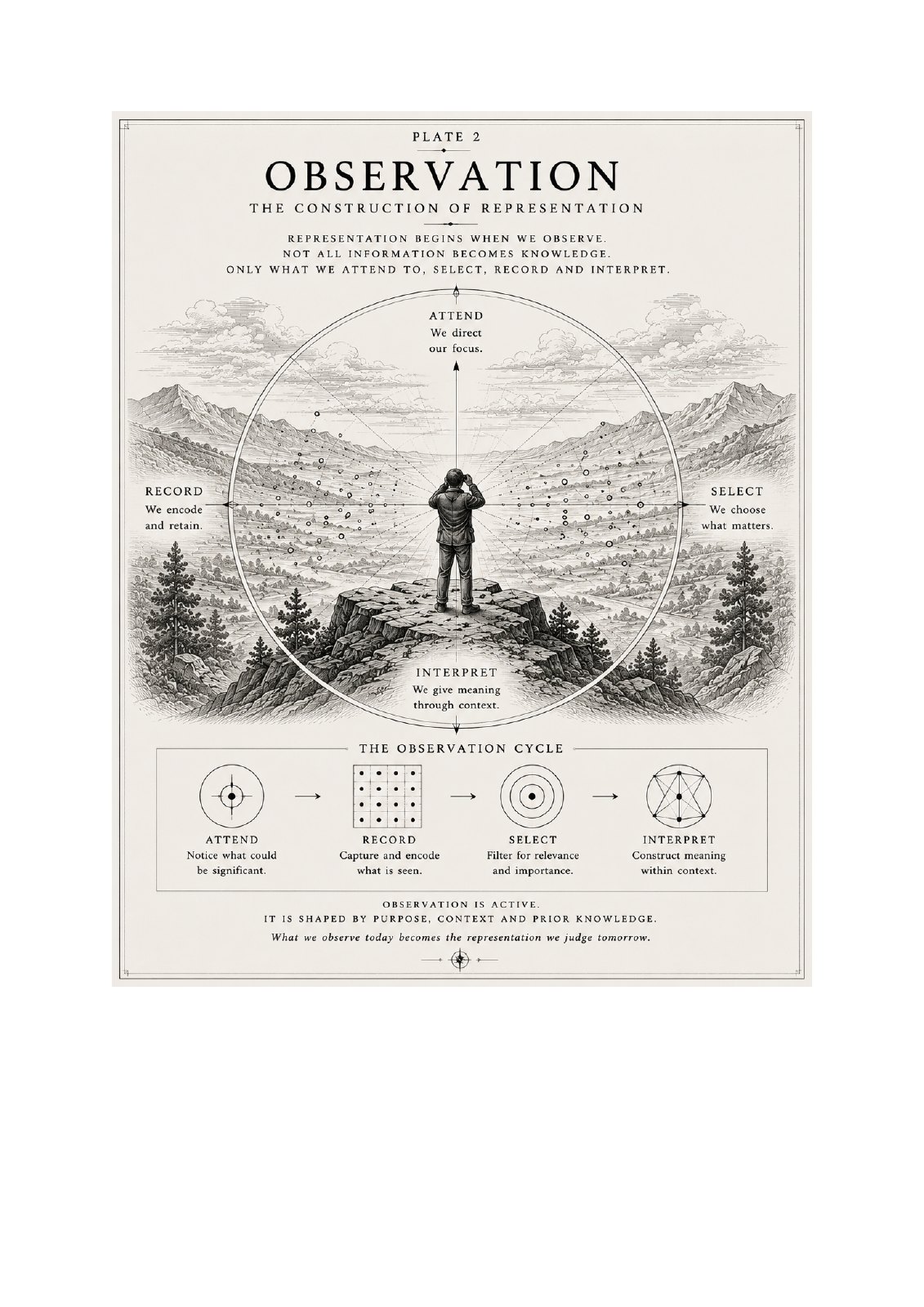
A field begins with what can be responsibly noticed.
The illustrated lesson
See the move.
Then make it.
Four web plates translate the Field Manual into a usable sequence: structure, application, record and practice. Read them in order, or return to the plate that your decision needs.
What is actually present?
Follow one bounded example through the method.
Running case / critical-component delivery
A critical component has arrived late three times. The first account says: “the supplier is unreliable.”
- 01Observe
Three recorded arrival times, the agreed schedule, two inspection records and one unanswered message.
- 02Separate
“Unreliable” is an interpretation. The dated events and records are observations.
- 03Bound
One component, one route, six weeks, named records. Performance outside that frame remains unknown.
- 04Record
Preserve each element with its source, date, confidence and unresolved gaps.
The problem becomes inspectable without pretending the first explanation is already proved.
A useful method leaves a record that another person can question.
Produced record
Element register
A bounded list of observations, records, actors, absences and constraints, each with source and status.
Provisional
Revisable
Revisable
01Source
Where did the information come from?
02Status
Observed, reported, inferred or unknown?
03Boundary
To what time, place and scale does it apply?
04Revision
What evidence would alter the account?
A category is not the thing itself. What stands out is not always what matters most.
A bounded 10 minutes field exercise.
01
Write the decision or question in one sentence.
02
List five things directly observed or recorded.
03
Mark every interpretation with “I infer that…”.
04
Add the time, place, source and boundary for each observation.
You are finished when another person can identify exactly what was observed without adopting your explanation.
The reading frame
What to look for
before you decide.
What is actually present?
- 01Distinction — what can be told apart
- 02Relation — what is connected
- 03Signal / trace — what leaves evidence
- 04Attention — what is selected or missed
- 05Memory — what persists
- 06Affordance — what becomes possible
- 07Constraint — what limits a move
In practice
Three useful
moves.
This prevents assumptions from hardening into facts and gives every later judgement a traceable base.
Separate observation from interpretation
Locate what is absent but consequential
Calibration notes
A category is not the thing itself
What stands out is not always what matters most