 1:32
1:32Field studies
What the Water Holds
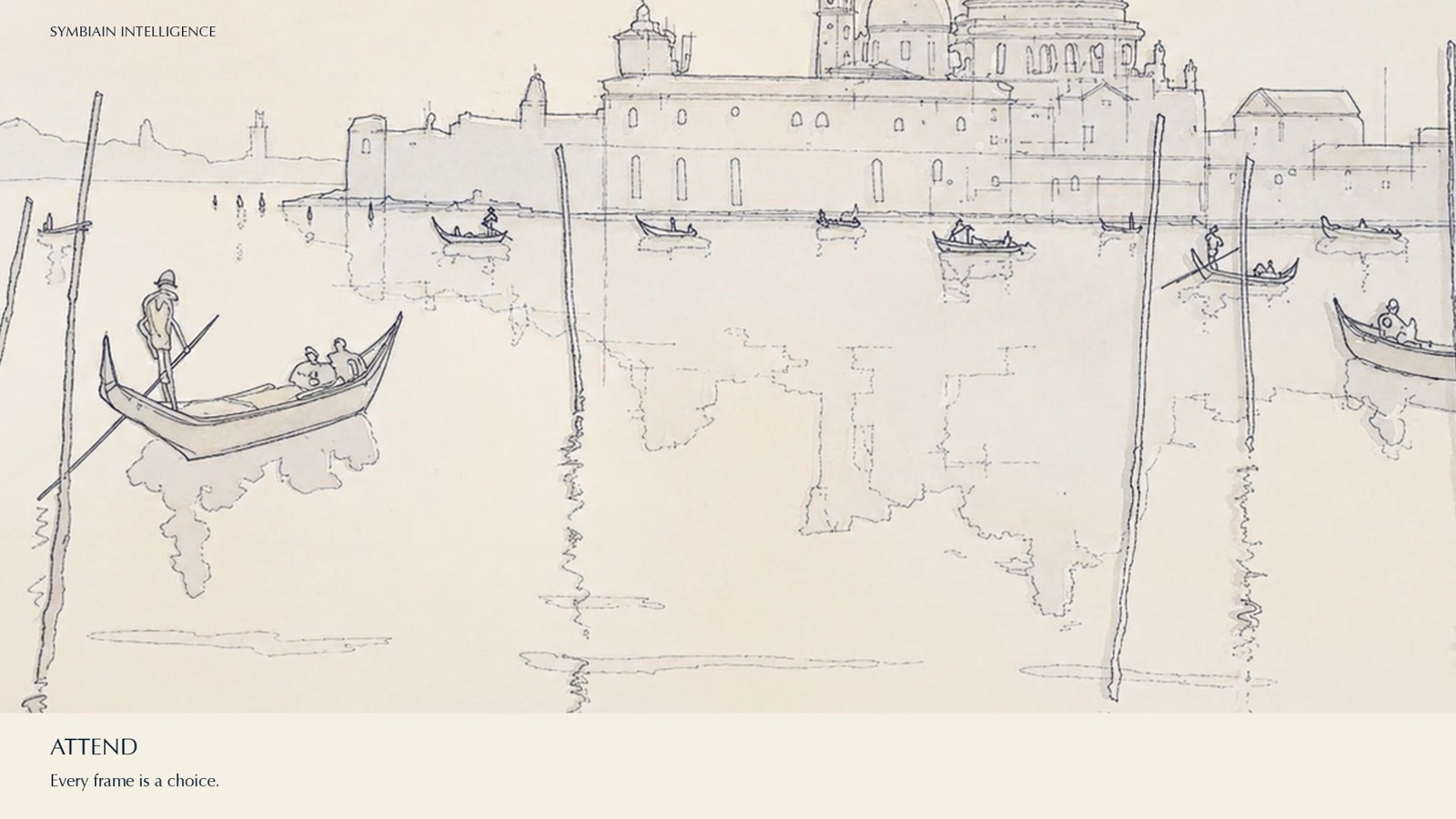
Venice, attention and change
A painting by John Davie becomes a moving study of water, architecture and attention—then returns to the original work.
Watch the filmField studies / 2:00
A Qingming-inspired study
About the film
A river city, a crossing and a changing field of relationships. Seven illustrated studies introduce observation, interpretation and calibration.
Creative line drawings based on supplied Qingming details. These are interpretations rather than documentary reproductions: fine details can differ. The film introduces the method; it does not establish historical facts or causal claims from the images.
Read alongside / English
Welcome to Symbiain Intelligence.
A field guide to decision integrity.
Begin with observation.
Name what can be seen, sourced, dated and bounded.
Keep the record distinct from the explanation you bring to it.
In the market, attend to relationships.
Who depends on whom?
What moves?
What is delayed?
A list of objects cannot describe those dependencies.
At a threshold, access and attention change.
Compare plausible interpretations.
Ask what evidence would distinguish them, and what remains outside the frame.
At the crossing, several movements meet a constraint.
A visible pattern suggests a question about mechanism.
It does not, by itself, establish causality.
Calibration brings confidence into proportion with evidence.
The watchers are visible.
Their motives are inferred.
Record that distinction, and specify what would change your judgement.
To examine drift, compare successive observations with a stated baseline.
A still image cannot show the change.
Identify which new records would reveal departure.
Return to detail.
Choose a reversible next step, a responsible owner and a review date.
Preserve what changed in the account, and why.
Human judgement retains authority.
Symbiain Intelligence.
Clearer evidence.
Better questions.
Human judgement.
Continue looking
1:32Field studies
Venice, attention and change
A painting by John Davie becomes a moving study of water, architecture and attention—then returns to the original work.
Watch the film