This interpretive case reads the Divine Comedy as a relational field in which place, guidance, memory, choice, consequence and the capacity to change acquire meaning through a journey rather than through isolated labels.
Casebook / 25
Dante’s Divine Comedy.
A moral universe organised as a journey.
What becomes visible when moral judgement is mapped as a journey through consequence, recognition and transformation?
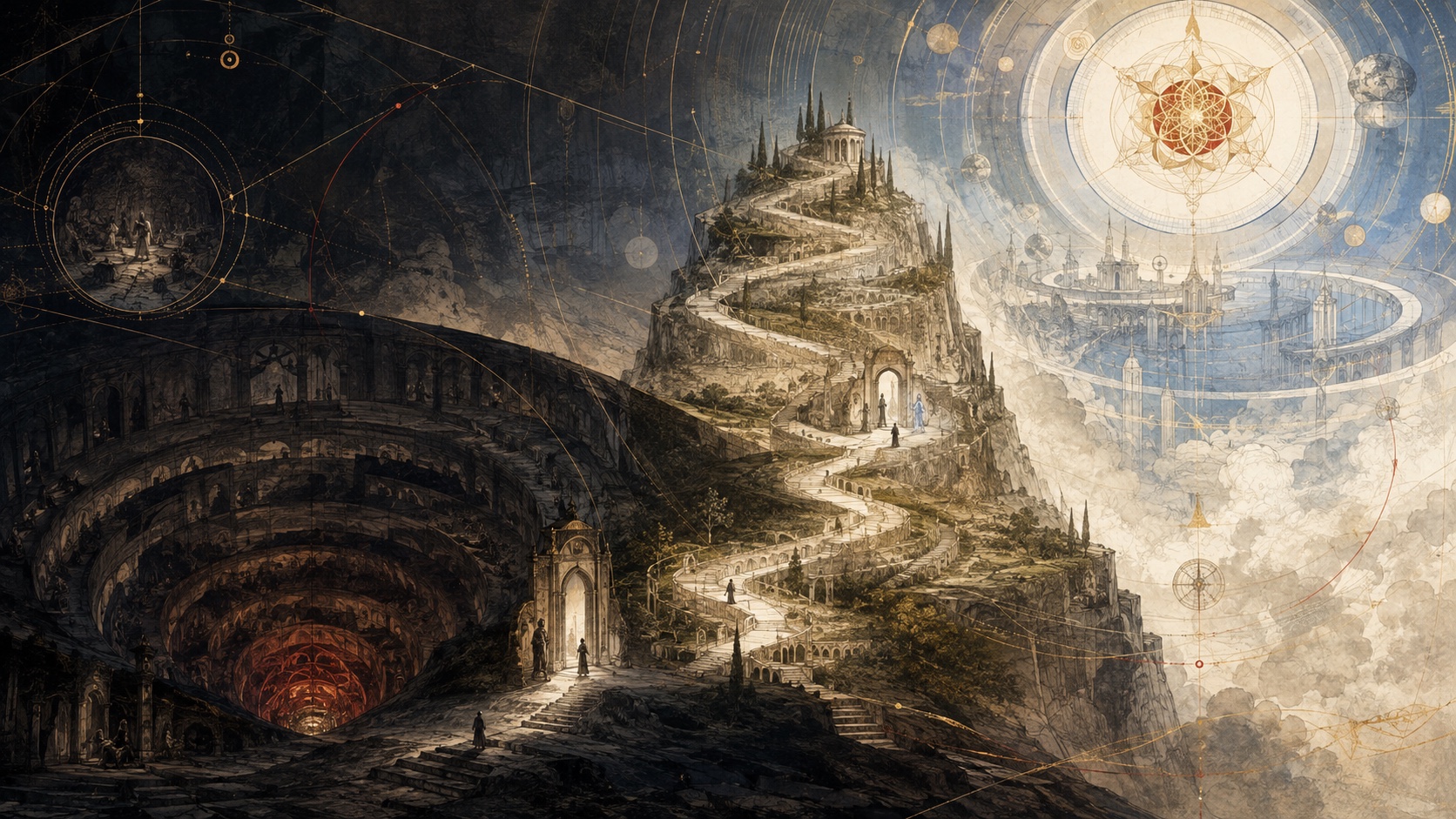
This page demonstrates a disciplined way of reading and comparing ideas. It is an interpretive aid—not a settled account, endorsement, rejection or substitute for the primary text and serious scholarship.
Relational atlas / the journey
The pilgrim is not outside the map.
Each encounter changes the traveller who is doing the seeing. The diagram keeps moral place, evidence, authority and transformation in one inspectable field.
THE PILGRIMIN RELATION
- 01 / Place
Moral geography
Realm and threshold locate the encounter, but location alone does not explain its meaning.
- 02 / Guide
Bounded authority
Virgil, Beatrice and other figures disclose different forms—and limits—of guidance.
- 03 / Memory
The life remembered
Personal, civic, political and classical histories enter the present judgement.
- 04 / Choice
Action and intention
Conduct is read through motive, habit, relation and the orientation of desire.
- 05 / Consequence
What the order reveals
Consequence makes a moral reading visible while the poem continues to complicate it.
A movement through the field
- I / Descent
Recognise distortion
Encounter consequence and the stories people tell about themselves.
- II / Ascent
Practise reorientation
Change is represented as effort, relation, time and renewed capacity.
- III / Vision
Expand the frame
The available perspective widens beyond the traveller’s starting categories.
- IV / Re-read
Return with a changed eye
Later passages can revise what earlier passages seemed to mean.
The case in plain language
Start with the question,
not the answer.
A list of virtues, faults or punishments loses the architecture of the poem. Dante’s traveller encounters different conditions, guides and limits across Inferno, Purgatorio and Paradiso; the movement between them changes what can be perceived and understood.
The method, step by step
Four moves.
One visible chain.
Symbiain keeps the moves separate: establish what is observed, relate the conditions, test the possible reading, and state what would require revision.
- 01 / Observe
What can we responsibly say?
The Divine Comedy is structured in three canticles—Inferno, Purgatorio and Paradiso—and follows a first-person pilgrim through successively different moral and cosmological regions under changing forms of guidance.
- 02 / Relate
What may connect?
The poem can be examined as an ordered field in which action, intention, habit, social relation, consequence, recognition and transformation remain connected. This is an analytical reading of the poem’s structure, not a claim to settle its theology or one final meaning.
- 03 / Test
What would distinguish the readings?
Which passages and structural relationships support a proposed reading, which credible alternatives remain open, and what changes when translation, historical context or a different canto is brought into the field?
- 04 / Revise
What would change the account?
Revise the map when the Italian text, another translation, historical scholarship, commentary, narrative sequence or a strong rival interpretation alters the relationship being claimed.
Why use Symbiain here?
From method
to practical value.
The insight is what becomes visible. The feature is what the method does. The benefit is what the user gains. The value is what can improve in the topic at hand.
- 01
Insight
In the poem, judgement is spatial, relational and developmental: where the traveller stands changes what can be recognised.
- 02
Feature
Connects textual location, guide, action, intention, consequence, memory and transformation while preserving the passage supporting each relation.
- 03
Benefit
Helps a reader see the architecture of an argument without reducing a complex poem to a moral slogan or plot summary.
- 04
Value
Offers a disciplined way to compare interpretations, expose their textual support and revise them when the journey complicates the initial reading.
What to examine
Five conditions
to hold together.
- 01Realm, threshold and direction of travel
- 02Guide, authority and limits of understanding
- 03Action, intention, habit and social relation
- 04Consequence, recognition and remembered history
- 05Transformation, expanded vision and return to the text
Tensions to hold
Judgement ↔ mercy
Fixed consequence ↔ capacity for transformation
Individual journey ↔ political and social world
Important boundary
Interpretive and educational case only. It does not establish a religious truth, settle Dante’s authorial intention, replace historical or theological scholarship, or claim that one diagram contains the poem. Every reading should remain linked to the relevant text, translation and context.
Sources & method
Sources support the stated observations only. All analytical readings remain provisional and should be tested against a defined purpose, scope and evidence base.