This independent public-source research case asks whether iron in recycled 6xxx aluminium should be examined not only as a bulk concentration, but as a changing population of intermetallic phases whose identity, morphology, spacing, connectivity, surface proximity and process history may affect corrosion behaviour.
Casebook / 28
Recycled aluminium & intermetallic topology.
Engineer the impurity state, then test the claim.
Can recycled aluminium be engineered around impurity state rather than impurity concentration?
This independent page turns a public-source hypothesis into a falsifiable research architecture. It is not a validated result, engineering instruction, claim of mandate or collaboration, or statement of institutional endorsement.
Experimental atlas / state
Do not let complexity win by complexity.
The topology hypothesis earns attention only if it adds reproducible value beyond chemistry and process baselines, survives held-out testing and predicts the result of a deliberate intervention.
THE ALLOY ASA CHANGING STATE
- 01 / Chemistry
Elemental inventory
Measure bulk composition and covariance without treating a total as the realised microstructure.
- 02 / Process
How the state was made
Casting, homogenisation, extrusion, heat treatment and pretreatment route chemistry into form.
- 03 / Topology
Particle population
Retain identity, morphology, density, spacing, clustering, connectivity and uncertainty.
- 04 / Surface
The encountered boundary
Keep sampling depth, enrichment, oxide and conversion state distinct from the bulk.
- 05 / Exposure
Transition through time
Observe initiation, arrest and propagation under a defined environment rather than one final score.
A movement through the field
- G0 / Join
Retrospective field
Connect specimen chemistry, process, characterisation, surface and corrosion records where permission allows.
- G1 / Match
Find natural experiments
Seek similar Fe with different topology and different Fe with similar topology.
- G2 / Compare
Blind the baseline
Test composition, composition-plus-process, topology-aware and full-state models out of sample.
- G3 / Intervene
Change the state
Use a small discriminating experiment to test whether the predicted transition actually moves.
Data integrity architecture
A missing join
is a finding.
The contamination hypothesis becomes testable only when the same material identity can be traced through feedstock, chemistry, processing, intermetallic topology, surface condition, exposure and corrosion outcome. Where that chain does not exist, the page must show the gap rather than complete it with inference.
- 01 / IDENTITY
Keep the specimen whole.
Batch, billet, extrusion, coupon and sampled region need a persistent identity that survives every hand-off.
- 02 / PROVENANCE
Keep the measurement honest.
Source, method, unit, timestamp, operator, detection limit and uncertainty travel with each value.
- 03 / CONTINUITY
Join the causal route.
Composition → process → topology → surface → exposure → outcome must be linked, not assembled from unmatched averages.
- 04 / ESCALATION
Stop at the broken link.
An unsupported transition becomes a visible gap, hold or request for evidence—not a silent conclusion.
CONNECTEDMISSINGSTALECONFLICTEDUNVERIFIED
The case in plain language
Start with the question,
not the answer.
Bulk composition is important, but it does not fully describe the microstructure or surface that an environment actually encounters. A topology-aware field could expose testable relationships across chemistry, processing, intermetallic state, surface condition and time—provided it is compared blind with simpler models and allowed to fail.
The method, step by step
Four moves.
One visible chain.
Symbiain keeps the moves separate: establish what is observed, relate the conditions, test the possible reading, and state what would require revision.
- 01 / Observe
What can we responsibly say?
Publicly available research from NTNU’s TEM Gemini Centre describes RACE as an NTNU and SINTEF project with Hydro and Benteler developing high-post-consumer-scrap 6xxx and 7xxx alloys while preserving corrosion resistance and mechanical performance. A 2026 open-access RSC Sustainability paper on post-consumer-scrap-based 6060 reported that observed specimen variation depended on extrusion details and oxide thickness rather than initial composition alone.
- 02 / Relate
What may connect?
Those public signals support a bounded hypothesis: realised metallurgical and surface state may contain useful information that bulk Fe content alone cannot represent. They do not establish that Fe-rich topology controls corrosion or that a new alloy or process will perform better.
- 03 / Test
What would distinguish the readings?
Against held-out specimens, does a topology-aware descriptor improve prediction or mechanism discrimination beyond composition and process history—and does deliberate intervention change corrosion behaviour in the predicted direction?
- 04 / Revise
What would change the account?
Narrow or reject the hypothesis if topology adds no out-of-sample value, if surface state or another simpler explanation dominates, or if an intervention fails to produce the predicted change. Do not generalise across alloy systems without transfer testing.
Why use Symbiain here?
From method
to practical value.
The insight is what becomes visible. The feature is what the method does. The benefit is what the user gains. The value is what can improve in the topic at hand.
- 01
Insight
An impurity total describes inventory; it may not describe the realised metallurgical state that governs a local transition.
- 02
Feature
Uses a persistent specimen identity to connect composition, process, particle-level topology, near-surface state, exposure, time and uncertainty—and flags every missing, stale, conflicted or unverified join.
- 03
Benefit
Helps researchers identify natural matched pairs, select discriminating experiments and see exactly where a complex model must outperform a simpler baseline.
- 04
Value
Creates a falsifiable route to test whether wider recycled-content acceptance could be supported by performance-based state descriptors rather than concentration limits alone.
What to examine
Five conditions
to hold together.
- 01Persistent batch, billet, extrusion, coupon and sampled-region identity across the evidence chain
- 02Bulk Fe, Mn, Si, Cu, Mg and Zn inventory with covariance
- 03Phase identity, morphology, size, density, spacing and connectivity
- 04Casting, homogenisation, extrusion, heat treatment and pretreatment history
- 05Near-surface enrichment, oxide or conversion state, exposure sequence, corrosion outcome and measurement uncertainty
Tensions to hold
Impurity concentration ↔ realised impurity state
Retrospective fit ↔ blind predictive value
Mechanistic plausibility ↔ experimental causation
Important boundary
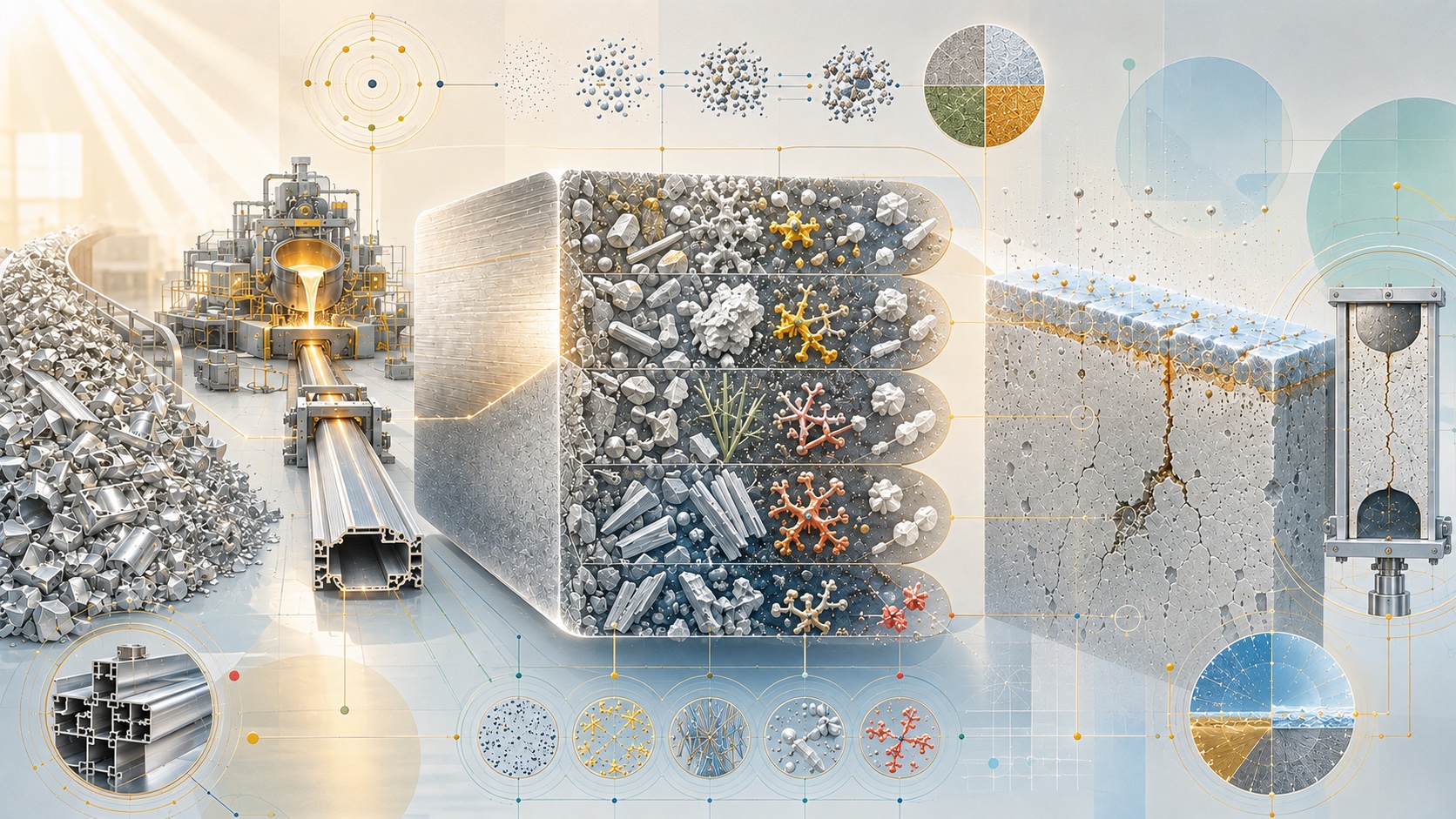
Independent public-source research case only. It was not commissioned, mandated, sponsored, reviewed or endorsed by any cited institution; citation establishes public research context and does not imply collaboration. The opening plate is conceptual art, not microscopy or performance evidence. The proposed relationship is a hypothesis, not a validated finding, alloy specification, corrosion assessment, engineering instruction or environmental claim. Real work would require permissioned data, specialist metallurgy and corrosion leadership, pre-specified comparison, laboratory controls and independent review.
Sources & method
Sources support the stated observations only. All analytical readings remain provisional and should be tested against a defined purpose, scope and evidence base.